Pages

Showing posts with label Author. Show all posts

Sunday, June 7, 2020

Roxanne Von Andrian - The IAN Interview


Although writing fiction is her first love, Roxanne has a Ph.D. in engineering, and an MBA from the State University of New York. She received awards for her work from companies such as GE. In addition, she is an inventor with three patents. She served as an executive and senior manager for high-level operations and quality design in the aerospace, defense, industrial, and energy sectors.

Roxanne and her family live in New York State. She wakes up every day with a sense of gratitude for the country that welcomed her, and pride for her two adult sons and their accomplishments.


IAN: Please tell us about your latest book.

Roxanne Von Andrian: My book DECEPTION is about a team of four European
operatives and INGRID, a CIA agent, who plot to steal enriched plutonium to poison an ex-KGB officer in London.

These four men, OSCAR, FERENCZ, ADI and CORNEL, under the Ceausescu’s Romania, had powerful roles in the political apparatchik. During the 1989 revolution, they turned against the communist regime. They meet again, as members of the Miklos Fund Board, in Bucharest Romania.

MIKLOS, an American multi-millionaire with Eastern European roots, opens the Miklos Fund to help the emergence of a civil society.

The team diverts money from the Miklos Fund to finance their plan of stealing enriched plutonium from the Russia-owned military base of Ukraine’s Sebastopol.

The team is acting under the guidance of a French op team who, with help from Italian assassins, plot to kill an ex-KGB officer in London by poisoning him. They make the assassination appear to be executed by the KGB. 

While working at MIKLOS Fund, Ingrid has several brushes with death.

The theft is orchestrated by a Ukrainian officer, LISA, who wanted to escape from Ukraine to start a new life in Romania’s Transylvania. The plutonium is hidden in three decoy tombstones made of cement.

IAN: Is Deception published in print, e-book or both?

Roxanne Von Andrian: DECEPTION is published in print, hardcover and paperback, and e-book. I recommend all versions; the quality of the print is very good, thanks to my well organized and perfectionist publisher Angela Hoy, and the cover illustration is wonderfully creative and representative of the content. I was lucky to have an amazing artist like Todd Engel to illustrate the cover!

IAN: Where can we go to buy Deception?

Roxanne Von Andrian: DECEPTION is available for purchase at:


IAN: What inspired you to write Deception?

Roxanne Von Andrian: My inner knowledge of life under the communists and later on, in France, before arriving to the United States, inspired me to write this spy thriller.

I am descending from a well-connected European family. While my family at large was victimized by the communist party and the KGB, part of my close family had the privileged life of those serving the communist regime, in the pattern of the victims embracing its tormentors. Such that, through family and friends, I was privy to deep state secrets that were occasionally spilled in my parents’ house.

I joined the Revolution of December 1989, which ended with the ousting of the dictator, Ceausescu, the collapse of communism, and the rebirth of democracy. My change of allegiance wasn’t left unnoticed. In 1992, I was working for the Soros Foundation for an Open Society when I asked for political asylum in Paris, France, because my life was in danger. My family and I moved from France to United States shortly after that.

I was an ocean away when European events made the news, like the assassination of Ipsinenko in London, Russia’s grab of Crimea, enriched plutonium popping up on the European black market, and the emancipation of the Eastern European countries out of Moscow’s communist control. I immediately connected these and other events to people I personally knew, the organizations they were part of, and to their years-long strife and hate of the Soviet Union and the KGB, the ideology enforcer. I realized that the public would never unlock the deepest secrets and the tenebrous characters that were behind these events. Why? – because the people I knew in my youth were so secretive and masters of deception and conspiracy, nothing in the world, neither riches or fame, would drag them out in the open.

IAN: How long did it take to write Deception?

Roxanne Von Andrian: I started writing the manuscript in 2017 and had it published in 2020. I wrote it during evenings, after a full-day work, and on weekends.

IAN: How did you come up with the title?

Roxanne Von Andrian: Its original title was “The Last Take”. I changed the title in 2018, after I had several discussions with Rhonda Roaring, an amazing personality and editor who peppered my manuscript with critiques of style and content, and ended up giving me a lot of titbits on writing and publishing advice. She told me the title sounded like a financial transaction, and I should consider a different one.

IAN: What do you hope your readers come away with after reading Deception?

Roxanne Von Andrian: My hope is that the readers will connect the dots between the real events the book is based on, and they will see the hidden truths behind each history lesson.  What is more fascinating than having a glimpse of the secrets under a history shakedown? – it’s like trying to see the entire iceberg when they show you the tip of it only. 

My literary agent, Mary Ellen Gavin, who I trust and love, says that my book gives the readers insight into what it would be like to work at CIA Headquarters and what it was like at the end of the COLD WAR.

IAN: Are experiences based on someone you know, or events in your own life?

Roxanne Von Andrian: My book Deception is based on characters I knew and on events in my own life. Most of the dialogues are documenting conversations I witnessed, while I was in the company of strongly minded, driven men and women, in my youth and childhood, who remained memorable over time, in my head.

While writing the manuscript, I cried many times, because of remembering the emotions, the suffering, or the risks taken by people who were so close to me. When the manuscript was complete, it felt therapeutic. Reliving the vivid memories, which I associated with the fictional deflections of the story, healed me somehow of the fears and terrors of my life in a dictatorship. 

IAN: Tell us about your next book or a work in progress. Is it a sequel or a stand-alone?

Roxanne Von Andrian: My next book is in a different genre than spy thrillers, and yes it is a stand-alone. I am planning to write a story of the paranormal. About the personal dilemma and tribulations of a woman who believes in God and develops supernatural powers, which give her gratification when accomplishing good deeds or “miracles” for unknowing people, but sometimes put her at odds with herself when people want to harm her.


Saturday, September 9, 2017

Phil Stephens: The IAN Interview

Phil Stephens

Phil Stephens is an Indiana native and a graduate of the Indiana University Kelley School of Business, and of the Dale Carnegie Course. He spent many years working in Fortune 500 America. Raised in a solidly Catholic family, he attended Catholic grade schools in the 1960s and served as an Altar Boy. His writing has appeared in the local newspaper and Pen IT literary magazine. His passions include reading in his favorite genres—history and horror. He also enjoys cooking, exercising, and the environment. Stephens resides in beautiful Brown County in Southern Indiana with his wife Marie, and has an adopted granddaughter, Crystal Maiden, in the Philippines.


IAN: Please tell us about your latest book.

Phil StephensBlack-robed nuns, priests, bishops, the select fraternity of Altar Boys, and the ancient ceremonies of the Catholic Church. Music of the ’60s, boyhood shenanigans, Cootie doctors, and coming of age. Set in the socially and politically tumultuous period of the 1960s, The Altar Boy is the fictionalized memoir of Carl Sanders, a funny, sensitive kid, who’s caught in the middle when his family is fractured by the intrusions of a priest. We follow Carl's confusion and pain as he watches the pious façade of the Church fall away to reveal unholy carte blanche, cover-ups, and collusion.

The book opens in the late 1980s. Carl and his brother down beer after beer at a favorite pub, trying to piece together their family’s chaotic past. The stakes are high—someone is about to return after a 20-year absence, threatening to re-ignite the family conflict. As the brothers’ painful recollections of their past become more traumatic, Carl drifts back in time to the era he tried for so many years to forget. 

The story is realistic, poignant, and at times very funny. Stephens shines a timely spotlight on the then-unquestioned power of the Church, while taking the reader back to the ’60s era of rock & roll, Catholic schools, social upheaval, and boyhood pranks.

IAN: Is The Altar Boy published in print, e-book or both?

Phil Stephens: It is currently published in print only.

IAN: Where can we go to buy The Altar Boy?

Phil Stephens: It is available at Amazon and Barnes and Noble.

IAN: What inspired you to write The Altar Boy?

Phil Stephens: True events...and a story that needed to be told.

IAN: Did you use an outline or do you just wing the first draft?

Phil Stephens: Some chapters I outlined and some I winged.

IAN: How long did it take to write The Altar Boy?

Phil Stephens: Longer than I'm willing to admit.

IAN: How did you come up with the title? 

Phil Stephens: I wanted a title that conveyed the subject matter of the book and grabbed the reader.

IAN: How much The Altar Boy of is realistic?

Phil Stephens: Most all of it.

IAN: How is The Altar Boy different from others in your genre?

Phil Stephens: Very little has ever been written about this subject.

IAN: What books have most influenced your life most?

Phil Stephens: David Halberstam (The Reckoning), Sun Tzu (The Art of War) and Carl Sagan (Contact)

IAN: Do you see writing as a career?

Phil Stephens: Yes, if my first novel takes off.

IAN: Do you recall how your interest in writing originated?

Phil Stephens: It is one of the few things I have a talent for.

IAN: Who designed the cover?

Phil Stephens: I did.

IAN: What was the hardest part of writing your book? 

Phil Stephens: Finding the time to do it.

IAN: Do you have any advice for other writers?

Phil Stephens: First of all START the book and then FINISH it.  Don't give up.

IAN: Tell us about your next book or a work in progress. Is it a sequel or a stand-alone?

Phil Stephens: It is a stand-alone novel titled "On The Edge of the Stairs." A story of a young couple very much in love and planning their wedding but then the girl dies in a tragic accident.  As the woman lay dying she vows to the man she will reincarnate herself and come back to him.  And she does.

Saturday, October 15, 2016

Joel Hirst-The IAN Interview


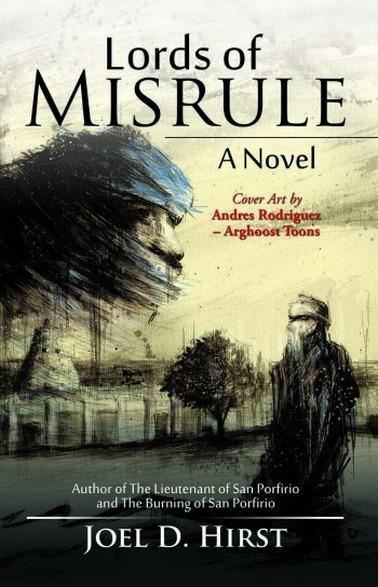
Joel D. Hirst is a writer and novelist. Author of the recently released “Lords of Misrule”, he has also written “The Lieutenant of San Porfirio” and its sequel “The Burning of San Porfirio”. He is currently working on “From the Camps”, the saga of a boy from a refugee camp in East Africa. Hirst has worked as an international aid worker for almost two decades, and has been a fellow at the Council on Foreign Relations. Hirst is a graduate of Brandeis University. He lives in Gilbert, Arizona.


IAN: Please tell us about your latest book.

Joel D. Hirst: “Lords of Misrule” is the story of a young Tuareg boy who is brought into conflict and forced to flee his country of Mali. It is about his journey across the Sahara to become an Islamic Judge (Qadi) and jihadist, before he finds something that changes everything in the dusty libraries of Timbuktu. It is the tale of the making and unmaking of a jihadist.

IAN: Is Lords of Misrule published in print, e-book or both?

Joel D. Hirst: Both.

IAN: Where can we go to buy Lords of Misrule?


IAN: What inspired you to write the book?


Joel D. Hirst: We are in the midst of a dramatic international conversation on the issue of violent Islam, especially as terrorist attacks keep hitting the west and the Islamic State and their atrocities dominate the news cycle. There is a tendency to oversimplify issues and appeal to stereotypes or to simplistic arguments, without recognizing that Islam also has its own history and people their own motivations. Through this novel, I am telling the story of a young Tuareg boy who gets caught up in Jihad, and why. And how he finds his way out of it – and what the consequences are. The novel delves a lot into Islamic tradition, as well as Tuareg/Saharan history. Specifically, it looks at traditions of rational thought in Islam, Aristotelian philosophical traditions that were lost almost 1000 years ago and have not yet been re-discovered, and what would happen if they were. It is a hard story, but an honest one which adds my perspective to some of the ongoing debate.

IAN: Did you use an outline or do you just wing the first draft?

Joel D. Hirst: That’s an interesting conundrum. I try to make an outline, and I usually know where my protagonist ends up at the end of the story before I write it. But when I sit down and start to write, the travails and travels and circumstances for the protagonist sort of write themselves. So I have found that I don’t do too well with a formal outline, just milestones that I want to arrive at and let the story fill itself in as I go along.

IAN: Do you have a specific writing style?

Joel D. Hirst: I use lots of magical realism in my writing. My novels series of “San Porfirio” were Latin American magical realist novels written as dictator novels. “Lords of Misrule” also has magic, this taken from Islamic and pre-Islamic Saharan traditions, which I think you’ll find both interesting but also gives flavor and color to our understanding of different societies. Besides that, “Lords of Misrule” is written in third person limited point of view. It is sweeping, and epic – and holds closely to the flavors and sights and smells of the Sahara.

IAN: What do you hope your readers come away with after reading your book?

Joel D. Hirst: I hope the book allows readers to reflect on the real reasons why terrorism exists, what some of the motivations could be, and what are some ways that the power of the mind is used to combat violent ideology. The book is not meant to lecture, it is instead meant to give people a look into the mind of a young man who finds himself fighting on the ‘wrong’ side and what he feels about that, and what steps he tries to take to save his soul.

IAN: What books have most influenced your life most?

Joel D. Hirst: More than individual books, authors. My favorite storyteller is W. Somerset Maugham; and it is from him that I learned how to story-tell (I like Moon and Sixpence; I love Of Human Bondage – although I found it immensely sad). I learned magic from Isabel Allende (not all her work I like, and her political leanings annoy me, but Eva Luna is a masterpiece). And Ayn Rand of course was pivotal in my understanding of the individual as the central character in their own story – the fight for freedom and meaning and reason (Atlas Shrugged of course, but I prefer The Fountainhead. That story is a little more honest and tries less hard to be philosophical).

IAN: Do you see writing as a career?

Joel D. Hirst: I would love writing to be a career. It’s a difficult time for new authors, as all writers know. Publishing houses only invest in a ‘sure thing’ and the ‘democratization’ of the publishing world, while a good thing, makes it a little hard to break through into to the general public. These are not complains, just realities. Writers have always faced challenging times to make themselves heard above the fray. This is not new. All that to say, right now I hold a day job, which I do love, but which also allows me the income and experiences to continue to write until one of my novels “makes it”.

IAN: Do you recall how your interest in writing originated?

Joel D. Hirst: I come from a family of educated folks. My father has a PH.D. and my house was always full of books. My brother is a journalist and a writer (non-fiction). So writing, as a natural result of thinking, has been something that I’ve known forever. I started writing fiction after living for 4 years in Venezuela during the apex of Hugo Chavez’s “revolution”, and saw so much there that was novel-worthy and that there was no way to express in non-fiction that I decided to tell a fictional story about what I had seen. The struggles of ordinary people to find meaning in their lives under political project that wanted all of their attention. The desires of the poor to be free from hunger, and the desires of the rich to be free from the poor. An honest story that does not really take a side, necessarily, but that shows why the ideas led to the apocalypse; all of this ended up being “The Lieutenant of San Porfirio”. I followed this up with “The Burning of San Porfirio”, which starts with the collapse of the political project and the death of “El Comandante” and follows the protagonists as they try to re-discover humanity and rebuild their lives after the revolution sputtered out. “A modern day, secular Pilgrim’s Progress” is what it has been called.

IAN: Do you have to travel much concerning your books?

Joel D. Hirst: I have been blessed with wide travel. I have visited four continents and more than fifty countries; Africa, North Africa, Latin America, and Europe. I have lived for more than thirty years overseas, in some of the hardest places in the world. These travels have made me sensitive; they have made me sad. They have robbed me of my feeling of invincibility and they have made me question a lot of what I believe and was taught. But my interactions with people has given me a deep commitment to their struggles, which is something that comes out in all my writing.

IAN: Who designed the covers?

Joel D. Hirst: The artist for all my novels is Andres Rodriguez, a company called Arghoost Toons. He is Argentina and lives in the southern interior of that country.

IAN: What were the challenges (research, literary, psychological, and logistical) in bringing your book to life?

Joel D. Hirst: Lords of Misrule is my best written (according to my editors), and most challenging, novel. It took me 2 years to research and another year to write. I had to research Islamic thought, philosophy, traditions and history. I also had to learn about Tuareg and Berber history and traditions and then I had to weave those together over the backdrop of an epic Saharan tale. All of this required a lot of reading and talking to Tuaregs and Muslims from different traditions. It helped that I was living in Mali for these years, and so I had direct exposure to so much of the fabric of the novel. And then the book went to an Islamic scholar to make sure it was accurate and respectful, as well as to an Amazigh (Berber) expert to ensure that the traditions of that ancient people were respected. It was a heavy life, and I invite you to pick up a copy and immerse yourself in something foreign, yet enrapturing.

IAN: Tell us about your next book or a work in progress. Is it a sequel or a stand-alone?

Joel D. Hirst: I have finished writing and am currently editing my 4th novel, provisionally titled “From the Camps”. It is the story of a boy’s from a refugee camp in East Africa and his hard journey to manhood, and meaning. It is a story of poverty and of violence – for too many people across Africa, it is their life’s story.

For more information about this author and his books click here > Joel D. Hirst

Saturday, September 24, 2016

Christine Meier: The IAN Interview


I was a Certified Shorthand Reporter (court stenographer) with the State of New Jersey (CSR) and a Registered Professional Reporter (RPR) and a Certificate of Merit writer with the National Shorthand Reporters Association. I worked as a per diem reporter in the New York City metro area on various civil lawsuits, primarily in depositions (discovery before trial). Eventually I got my Associates Degree in Biblical Studies from Christian International. I became a minister in 1999 and volunteered as an ordained minister in street ministries, soup kitchens, prison ministries, nursing home ministries, both at-risk and women’s outreaches. I’m now ordained with the Fellowship of Christian Assemblies. Started Christ-Centered Ministries for Worldwide Worship, Inc., in 2002. It’s become a teaching and preaching ministry with a house church located in Pensacola, FL. We live on a working farm which keeps me way too busy, well fed, but not rich in money; although, nature is God’s elixir. I get to see things in God’s creation most folks only dream about. In that I am truly blessed.  


IAN: Please tell us about your latest book.

Christine Meier: Have you ever wondered how our diverse nation got along to begin with and why we were able to work with one another up until the last fifty years? Let’s just state the obvious: The religious, agnostics and atheists aren’t leaving the country any time soon. 70 Years of American Captivity reveals documentary proof of a non-sectarian covenant applying to all Americans within our Federal Compact. Pursuing a non-judgmental approach, proving God is NOT judging” America, while revealing historic, scientific and documentary evidence the Federal government has broken its covenant to the citizens it swore to protect. Taking screen shots through 500 years of American history allows readers to become infused with a flavor for a very distinct American covenant, which ties religious, economic and non-sectarian goals under one umbrella of Federal awareness. Exploring solid solutions with over 900 sourced endnotes, you’ll learn how our diverse nation got along and continued to work out our differences, making it a birthplace of liberty and ingenuity. Before we trust any more tax seasons or election cycles to a Federal government in the throes of betrayal, this book reaches out to all walks of life with hope for the future.

IAN: Is 70 Years of American Captivity published in print, e-book or both?


Christine Meier: It is published in ebook, paperback and hardcover.

IAN: Where can we buy a copy of 70 Years of American Captivity?

Christine Meier70 Years of American Captivity is available at AmazonItunesBarnes& NobleKobo and Smashwords.   

IAN: What inspired you to write 70 Years of American Captivity?

Christine Meier: I had an experience with the Lord one day and what He told me compelled me to research and write this book.

IAN: Did you use an outline or do you just wing the first draft?

Christine Meier: Well, I start writing and then chapter titles and outlines, which become chapters sort of “arrive” on the scene.

IAN: How long did it take to write 70 Years of American Captivity?

Christine Meier: It took between three and a half to almost four years to research and write.

IAN: Do you have a specific writing style?

Christine Meier: I suppose I do, but it may not be as obvious as one reads. As I write, I answer questions I feel I would ask or readers would ask. It’s not really that obvious, but I do find myself writing as Zechariah did in the Old Testament. I like to put what I’m writing down for awhile and then pick it back up again. If it speaks to me after not working on it for some time, then I know it will bless those who read it.

IAN: How did you come up with the title?

Christine Meier: It was based on the statement the Lord gave me, but the subtitle was a work in progress with my publishing house (awesome folks).

IAN: What do you hope your readers come away with after reading 70 Years of American Captivity?

Christine Meier: The reality of how close we are to losing our country, and how far we have gone down the rabbit hole in lies we have been told; but more importantly, how easy it is to get us back on track, economically, spiritually and socially.

IAN: How much of the book is realistic?

Christine Meier: All of the book is from factual and actual history. In other words, it really happened. It is non-fiction.

IAN: Are experiences based on someone you know, or events in your own life?

Christine Meier: Some of the experiences related in the book are mine; some are shared through actual historic accounts and some are related through historical writings and other literature.

IAN: Did you have to travel much concerning research or for other aspects of 70 Years of American Captivity?

Christine Meier: I have traveled to four continents for the church books I have written and I have traveled for this one as well. Of course, I would travel anywhere to share this book and my other ones.

IAN: Who designed the cover?

Christine Meier: The cover design was a joint effort between the publishing house and myself. I love what those guys did with the ideas.

IAN: What was the hardest part of writing 70 Years of American Captivity?

Christine Meier: I had to make absolutely sure what I wrote was actual and factual history. That means I had to make sure what I wrote had original sourced beginnings. My writing in the past has been in biblical study. Fortunately, original sources are also crucial in that genre. This was quite different as revealing American history— and American history that is not widely known nor studied in most colleges.

IAN: Did you learn anything from writing 70 Years of American Captivity and what was it?

Christine Meier: I learned a tremendous amount of American history, early American thought and psychology as it related to the formation of our governing compact. I also developed a deep appreciation for how different our country truly is in its birth, formation and governing documents. I learned so much that today’s press, colleges and media are not telling Americans.

IAN: Tell us about your next book or a work in progress. Is it a sequel or a stand-alone?

Christine Meier: I have a prophetic study book and a gifts of the Bible book in the pipeline next.