Pages

Showing posts with label thriller. Show all posts

Sunday, August 16, 2026

Mark Grenside is the author of the Marcus Riley Thriller Series

 Sunset Circus


Thriller

Producer Marcus Riley believes dangerous stories belong on screen. That changes when Charlie Foster, a former Hollywood prop buyer now scraping by on Venice Beach, presses a riddle into his hand. Hours later, Charlie is found dead outside Sunset Circus, a pawn shop in Los Angeles.

When the police start asking questions, Marcus realises Charlie's puzzle points to the Miksas, a Nevada crime family who rule on two buried secrets: a fortune in Romanov treasure smuggled out of Russia by Olga Miksa's father, and an act of Cold War betrayal that bought the family's immunity from East and West alike.

With his partner, designer Melinda 'Mako' de Turris, Marcus follows the trail into the Nevada desert, uncovering an assault on Charlie's daughter at The Mighty Bison casino and the theft of an artefact the Miksas must recover, one that ties back to the lost Tobolsk urns and the Eremin Letters, and forward to Stalin's darkest secret. Olga and her daughter Lexi Miksa will do whatever it takes to hold on to power, and the deeper Marcus and Mako dig, the higher the body count climbs. Riley digs into the past, but he could end up digging a grave for himself.

Mark Grenside - The Independent Author Network

Sunday, April 29, 2018

Carl Lakeland: The IAN Interview

Carl Lakeland


I live in Australia. A one horse sleepy town called Snake Valley, roughly 35 clicks south of Ballarat. You may’ve heard of it. Ballarat is famous for the gold rush of the mid to late 1800’s. I enlisted into the military at the age of seventeen, which the time I’d spent in there gave me much juice to write about. But after leaving the military, I spent my life doing average things and living an average life. Find a girl. Get in a rock band and do some gigs. Make some money and lose it again. Make mistakes. Make the same mistakes. Lately though, I spend time with my wife and my horses, and my manuscripts that mostly live in my head until I get them out into the world. I never had any big dreams for making it in the crazy world of the big time players. I just like to write and the process of doing it makes me happy. I also get a kick out of watching my wife’s face all curl up when she’s reading my latest drafts.


IAN: Please tell us about your latest book.


Carl Lakeland: Eagle Shield was supposed to be the prequel to Project Amber (My first book)
But I changed my mind and I now call it book #1. It is a military spy thriller. However, my writing style takes me to other places and the story can easily fit into other genres. Yes, it has blood and guts. A whole lot of profanity. I write honestly and I make no apologies. It’s not for everyone and I wouldn’t give it to my kids to read. (they’re now reaching their twenties…) And the story is set in Australia’s outback with all its wonderful locations, flora and fauna. It is very fast paced. And I wrote it with a purpose to be easy to read. Readers will be left panting for breath, so, there’s no point stumbling over complicated words when everything is cracking past, half the speed of light. I have put a lot of effort into giving my characters a voice all to their own. You’ll meet classic outback Australian individuals with their slang and dialect. You’ll meet city folk who speak with an educated tongue. You’ll meet soldiers, cops, intelligence officers, and even someone who is not from this world. If someone was to ask me to describe this story in one line, I’d say, “You’d bloody-well better put your seatbelt on…” 

IAN: Is Eagle Shield published in print, e-book or both?

Carl Lakeland: Yes. Project Amber is in both formats now. Eagle Shield is in print at the time of this writing but will be in ebook very soon. I actually have a ebook on my desktop right now, ready to upload.

IAN: Where can we go to buy your books?

Carl Lakeland: You can grab a copy from links I have on my website. https://carllakeland.com There are too many buying options to list here. You will be spoilt for choice.

IAN: Did you use an outline or do you just wing the first draft?

Carl Lakeland: I’ve completed a few writing courses before I wrote my first book. In fact, Project Amber was born out of one of the courses I graduated from. The answer to this question is, yes, I wing it. We call it ‘writing into the void’. I have at least attempted to be a good boy and ‘structure first’ but it never worked for me. But I must admit, for me at least, I already have an entire novel in my head before I start to write. Just the way I am.

IAN: How did you come up with the title?

Carl Lakeland: I didn’t have a title until I was well into both books. That’s one thing I tend to leave alone. The reason is that the title is something not to take lightly. A good title will help sell a book. Message to everyone out there, do not write a title straight away. It will come to you when you least expect it. Don’t get all hung up on it. That said, I think I read a book once that was actually called, ‘Untitled”. True.

IAN: What do you hope your readers come away with after reading your books?

Carl Lakeland: A feeling that never leaves. Or at least lasts a long time.

IAN: How is Eagle Shield different from others in your genre?

Carl Lakeland: I wanted to read a spy thriller set in Australia. About ASIO and ASIS. About lies and secrets. I couldn’t find one. So I wrote one.

IAN: If you had to choose, which writer would you consider a mentor?

Carl Lakeland: Mathew Reilly. Or, Andy McNab… Or, Lee Child. No… Mathew Reilly. Really…

IAN: What book are you reading now?

Carl Lakeland: Ahem… If only I had the chance. But, I’ve been really into a book called The Hills of Mare Imbrium by Carleton Chinner. A fantastic moonscape sci-fi. Sci-Fi fans won’t be disappointed with this one. Let me tell you…

IAN: Name one entity that you feel supported you outside of family members.

Carl Lakeland: The Australian Writers Centre. A great bunch of guys to hang out with.

IAN: If you had to do it all over again, would you change anything in your latest book?

Carl Lakeland: It’s a good question and as all writers are, we’re never completely satisfied with our final draft. There’s always something lurking. It’s a matter of letting go, I suppose.

IAN: Do you recall how your interest in writing originated?

Carl Lakeland: Yes. I was thirteen. I wrote a short story for a school competition. And I won. But I was never any good at reading. I was slow and still am to this day. Dyslexia. Even though there must’ve been a whole bunch of spelling and grammar issues, it was the story by itself that got the attention. My very first thriller, you could say. I was thrilled.

IAN: Who is your favorite author and what is it that really strikes you about their work?

Carl Lakeland: Mathew Reilly. No fluff. No bullshit. Just in your face writing.

IAN: Who designed the covers?

Carl Lakeland: My covers were designed by Alisha at Damonza.com. But with my input and my choice of fonts. Later, Simon Critchell who was appointed by Aurora House changed a couple of elements. And I was still able to give my own input. I made sure the covers reflected what’s going on in the story. After you read it, you’ll make the connection with tiny clues of imagery included on the cover. I get most annoyed if I pick up a book to read and the cover is all wrong, not reflecting anything.

IAN: What was the hardest part of writing your book?

Carl Lakeland: The chapter called Presence in Eagle Shield. It was very hard and very sad to write. I was in tears as I wrote it. (Absolutely the truth.) I stumbled over it so many times. I even scrapped it and re wrote it. But every time I re wrote it, it ended up the same. It ended up just as hard to write as the others I attempted.

IAN: Do you have any advice for other writers?

Carl Lakeland: The one thing I can offer is this. Don’t give up. Always believe. The universe gives only to believers. The more you believe, the more the universe makes things happen. Read lots. Write lots. And believe in what you’re doing.

IAN: Tell us about your next book or a work in progress. Is it a sequel or a stand-alone?

Carl Lakeland: I briefly mentioned Project Amber which is book #2 and it is available now. Book #3 is now in the final stages of the first draft. The Lost Ones. This one is a little relaxed compared to Eagle Shield and Project Amber. And I’m afraid if I mention anything about this book, it will be a major spoiler. And I don’t want to give away any spoilers, folks. 


Sunday, February 14, 2016

Phil Rowan – The IAN Interview


I started writing fiction as a student at Trinity College, Dublin, and continued as a journalist in Athens and then as a leader writer on the Daily Express in London. I had a brief period as a University Tutor, but then set up my own business as a Creativity Consultant with Accountants and Management Consultants - where one challenging contract involved my trying to show nuclear scientists where they might dispose of nuclear waste! I then moved to writing fiction full time, which I love and want to take further.


IAN: Please tell us about your latest book.

P. Rowan: Harps & Tears centres on Bronkovski, a Polish/US nuclear scientist whose wife left him for a Jewish environmentalist. He is furious, and intent on revenge against Israel. When we meet him he is making a nuclear bomb in Ireland's West Cork for ruthless Islamic activists. My main man, US journalist Rudi Flynn, is lured in and seduced by Irish charm and blarney, but he knows that Middle East money is funding the deviant nuclear scientist in Ireland. There are ruthless rogues everywhere, including Irish politicians, but Flynn's lesbian hotel receptionist agrees to seduce and probe the evil Bronkovski. Despite his battered self-esteem following his wife's affair with another woman, Flynn soon meets a  succession of enchanting women - in particular, ex-prostitute, Claire, with whom he embarks on a passionate love affair. As he blunders into the terrifying conspiracy between Bronkovski and his Middle East funders, Flynn gets warned off and is eventually assaulted, with a near death experience involving murderous assassins. Eventually, however, there is sufficient evidence to persuade Irish politicians, who have been backing Bronkovski, to disown him, which allows British aircraft to bomb the deserted Irish seminary for missionary priests, where he has been hiding.

IAN: Is Harps & Tears published in print, as an eBook or both? 


P. Rowan: It is an Amazon Kindle e-book.

IAN: Where can we purchase a copy of Harps & Tears?

P. Rowan: Kindle copies at http://amzn.to/XkUuHq  All my books available at http://viewAuthor.at/PhilRowan Visit my IAN page for more info about my 4 dark humor thrillers - http://bit.ly/1CapXQX

IAN: Do you use an outline or do you just wing a first draft?

P. Rowan: I used a story outline and then chapter outlines for my 4 dark humor thrillers. But I am doing just chapter outlines for my current book as I'm not quite sure yet where it's going.

IAN: Do you have a specific writing style?

P. Rowan: I used first person present tense (taking on the identity of my main man Flynn) for my dark humor thrillers. But for the story I'm presently writing, I have reverted to third person past tense, and I am enjoying the different writing experience.

IAN: How do you come up with your titles?

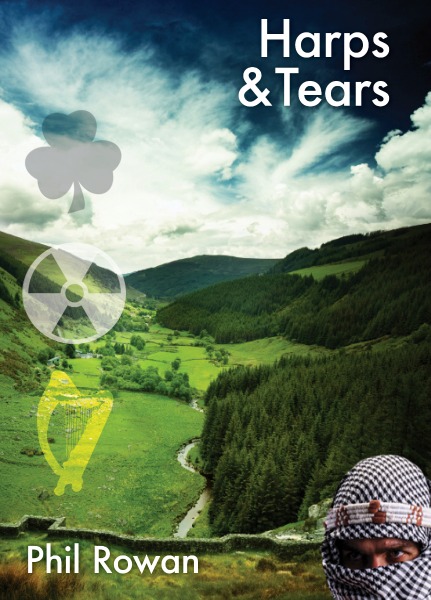
P. Rowan: Dark Clouds features a nuclear mushroom cloud cover as ISIS try to nuke London. Weimar Vibes has a movie picture of Marlene Dietrich on the cover as I was trying to present an image of those dark 1930s pre-war days in Germany. Under Cover has (I think) a rather attractive spy + flags for the main undercover secret service agencies. Harps & Tears is set mainly in Ireland, where I've got a nuclear symbol (for the nasty scientist) + a shamrock and a harp - with a scary jihadist waiting covertly for evil opportunities, which will bring tears to the eyes!

IAN: How much of Harps & Tears is realistic?

P. Rowan: Well - rural Ireland is maybe a good place for an embittered Polish American nuclear scientist to construct nuclear weapons, which can then be shipped secretly in fishing boats or covert (at the time maybe Libyan) submarines to the Middle East. It hasn't happened yet ... but who knows what might evolve!

IAN: What books have most influenced your life?  

P. Rowan: As a young Catholic growing up in Ireland, I was very much taken with those authors who were banned by the Church! My favourites were by James Joyce, J.P. Donleavy and Henry Miller. But I was later drawn to Scott Fitzgerald, Ernest Hemingway and - much later - Primo Levi, who shocked and moved me with tales of his survival from an Auschwitz nightmare.

IAN: If you had to choose, which writer would you consider a mentor?

P. Rowan: James Joyce or J.P. Donleavy - but maybe Scott Fitzgerald if I met him in Paris!

IAN: What book are you reading now?

P. Rowan: Brooklyn by Colm Toibin. I was hooked by the movie, which was great, and I'm enjoying the adventures of young Eilis in New York, where - like a lot of my ancestors - she escaped to from the problems many faced in Ireland since the famine.

IAN: Do you see writing as a career?

P. Rowan: Oh yes - although one might need some other source of income, as it's a very competitive business - and one has to make a great effort - but it is very satisfying!

IAN: Do you recall how your interest in writing originated?

P. Rowan: I got the impetus one afternoon during my first year as a student at Trinity College in Dublin. I sat down and started to do a short story about an attractive woman. My pen just kept moving to the end, and I was fortunate, because it was taken up by a small College magazine, which encouraged me to continue - although I was diverted for some not very satisfying years as a UK tabloid journalist.

IAN: Did you have to travel much for your book research?

P. Rowan: My work as a journalist took me to quite a few places around the world, and when I then moved on to an academic post, I was fortunate in having long paid leave periods, so my wife and I were able to travel extensively ... at least until our kids arrived!

IAN: Tell us about your next book or a work in progress. Is it a sequel or a stand-alone?

P. Rowan: My next story is a stand-alone. It is about a young Irish playwright, Jack, and his actress girlfriend, Maria, who - out of nowhere, but with a great play - catch the attention of a Hollywood agent and take a flight to LA. The agent wants Jack to write a screenplay, while Maria is offered a small movie part. It goes well for a while, but Jack gets distracted by another woman, so Maria takes off for India. We then follow their amorous and other adventures from two perspectives ... only I'm not quite sure how the story is going to progress, but I'm enjoying the writing!

IAN: Do you have any advice for other writers?

P. Rowan: If you get the urge, just sit down with a pen (preferably a biro) and scribble away for 40 or 50 minutes. If you cover a few sheets of paper without stopping, you're probably well under way and won't want to stop.

IAN: Do you have anything specific that you want to say to your readers?

P. Rowan: Mainly I just want to write down what I feel impelled to say, although one must put it in such a way that it will/can draw in one's readers. If it works for you, the chances are that others will also be taken by what you've written ... and the watchwords for all aspiring writers have to be 'don't ever stop scribbling!'

Monday, October 5, 2015

Rebecca Bryn: The IAN Interview


I live on a smallholding in West Wales with my husband, rescue dog and a flock of sheep. A self-taught artist, I paint the fabulous coastal scenery in watercolour and have work in private collections worldwide. I love walking, gardening, good company, and anything creative. My stories reflect my interests and my concerns, my love of family, animals and the countryside, my hatred of injustice and intolerance, my determination, and my sometimes gravely-challenged ability to forgive. I’m fairly laid-back, have developed a pretty thick skin, and I rarely get angry. I suppose I’m a contradiction.


IAN: Please tell us about your latest book.

R.B.: Touching the Wire, my second published novel, is set the Nazi death camp of Auschwitz, in 1944-45, and also in 70s and present-day England. It’s a story of the women of the holocaust and the effects the holocaust still has on our lives. It’s dedicated to the memory of a very special Polish Jew whose pain haunts me still.

Miriam, a Jewish nurse, steps down from a cattle wagon into the heart of a young doctor. As their relationship blossoms, they fight to save lives amidst the horrors of a death camp, joining the camp resistance and risking death daily. Liberation catapults them from one hell into another as they are separated. While Miriam is left behind in the camp infirmary, sick with scarlet fever, the doctor is forced onto the March of Death across Poland in the bitter January of 1945, taking with him stolen evidence of war crimes.

In post-war Britain, to protect his new family, the doctor fails to keep his promise to reveal the truth about the death-camp doctors and is haunted by guilt. It’s his granddaughter, Charlotte, seventy years later and fighting her own demons, who unravels her grandfather’s past and keeps his promise to his lost love.

IAN: Where can we go to buy your books?

R.B.: My second novel, Touching the Wire is available in e-book or print at http://author.to/TouchingtheWire

My first novel, The Silence of the Stones, a psychological thriller set in West Wales is available at http://author.to/TheSilenceoftheStones also in e-book or print.

IAN: Tell us about your next book or a work in progress. Is it a sequel or a stand-alone?


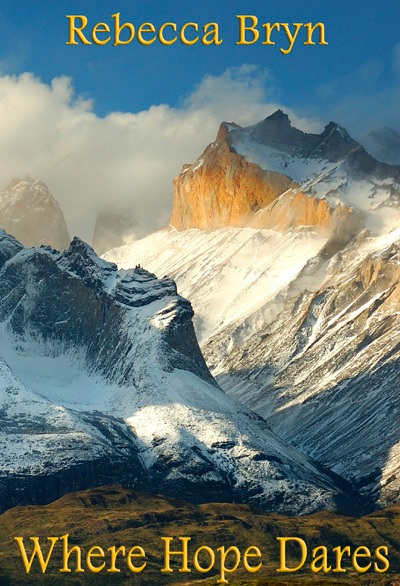
R.B.: Where Hope Dares is my third novel, a stand-alone thriller, and I hope to release it later this month.

Where Hope Dares is available for Kindle at http://getbook.at/WhereHopeDares

It’s a story of courage, faith and hope in the eternal struggle of good over evil.

In a time of social, religious and political upheaval, two isolated cultures clash with devastating results. Kiya, a young healer, is kidnapped and brutally raped by Alaric the Chosen to fulfil the ancient prophecy of The Gift. He takes her north across the High Atlas Mountains of Morocco to the high priest of one of his people’s pagan gods.  Raphel, Kiya’s storyteller husband, embarks on a thousand-mile journey to rescue her from the high priest’s warmongering regime. Kiya and Raphel both look to Abe, an enigmatic peddler for aid, but Abe has a secret agenda of his own – a prime directive dictated by a long-dead pope. The two lovers find help where they least expect it, but who can they really trust – friend or foe?

IAN: What inspired you to write Where Hope Dares?

R.B: Where Hope Dares was inspired by current scientific thinking about the past, present and future of our planet, and mankind’s less than beneficial stay upon it It’s also inspired by our strange relationship with our gods, and religious and racial tolerance as a whole.

IAN: Did you use an outline or do you just wing the first draft?

R.B.: I rarely use an outline. I have an idea of a beginning and a notion of the end. How I get from one to the other is largely down to my characters and where they take me. It’s usually a dramatic, painful and circuitous route, for them and for me.

IAN: How long did it take to write Where Hope Dares?

R.B.: Where Hope Dares was actually the first novel I wrote, back around 2004. Then it was called Destiny, and wasn’t very good: I’ve learned a lot about writing, character development, settings and research during the last eleven years. But I always liked the story, and still felt strongly about the issues that led to its conception so, last year, I decided to rewrite it. I spent about six months converting the tale to my new and, hopefully, more readable style of writing. I then sent it out to beta readers who informed me of its many shortcomings. Obviously much had been lost in ‘translation’. This was a setback I hadn’t anticipated but I was undaunted: all criticism is valid and useful – it’s just a matter of knowing how best to make use of it and apply it. Fortunately, one reader, who has since written me a brilliant scientific ‘afterword’, suggested I gave a more prominent role to Abe, an itinerant peddler and one of my minor characters. It took several months to ponder how this could be achieved and how it would impact the plot, and six more to weave what was essentially a new character into the original story, but it has transformed the novel, given it added depth and lifted it, I think, to a higher plane.  So, you could say it’s taken me eleven years to write Where Hope Dares.

IAN: What do you hope your readers come away with after reading Where Hope Dares?

R.B.: Oh gosh. That’s a difficult question to answer. I hope they value what and who they have. I hope they see greed and intolerance as evils. I’d like to think they’ll see our planet as a fragile and beautiful thing that we should protect at all cost, not plunder indiscriminately for a quick buck: it’s the only one we have and we have a duty of care to all the creatures that share it with us. I hope they see religion for what it is, a comfort and a way of life to those who believe, whatever their creed, not a weapon to beat others’ religions with. I’d better get off my soap-box.

IAN: How much of the book is realistic?

R.B.: The science behind it is as up-to-date and factual as I can make it. The history of the Oromo people and the settings were researched, as were the biblical texts that drive the underlying story and sub-plot. The characters and the coming together of the three aspects of the tale are entirely figments of my imagination.

IAN: How is Where Hope Dares different from others in your genre?

R.B.: I’d like to think it digs deeper, both into mine and my readers’ psyches. I’d like to think there are important issues underscoring the story: things like love, loss and hatred, tolerance, faith and what we build faith on, the errors of corporate greed, political and religious idealism and fanaticism whether for good or evil, and the diminishing resources and overpopulation of our planet.

IAN: If you had to choose, which writer would you consider a mentor?

R.B.: I think Tolkien’s skill at creating great characters with moral strengths and weaknesses, and providing richly-described settings and a believable, totally-grounded and historically-documented world has to be the greatest influence in my writing. Not that I could ever hope to emulate his work.

IAN: Name one entity that you feel supported you outside of family members.

R.B.: My long-time friend, Sarah Stuart, author of romances Dangerous Liaisons and Illicit Passion, has been a huge support throughout my life and my writing career. She is my harshest and most honest critic, and also helps with editing and proof-reading my novels. (aka tearing apart rubbish and ‘upcycling’ it J)

IAN: Did you learn anything from writing Where Hope Dares and what was it?

R.B.: All the research into my novels has taught me something. The Silence of the Stones taught me about rune-casting, in fact I actually used real rune-casting to drive the story, and also it opened my eyes to mental illness. Touching the Wire gave me a humbling insight into the holocaust and makes me grateful daily for what I have. Where Hope Dares kept me awake at night, thinking of what man is doing to the earth, but the research also gave me hope that the planet will survive despite our attempts to destroy it. The writing process itself has made me realise that I never give up. The bigger the challenge, the higher I climb.

IAN: Do you have any advice for other writers?

R.B.: Research, research, research. Then write, take criticism and act on it if it improves your writing and the story. Rewrite, edit, proof-read, take on board suggestions with an open mind but stay true to yourself. Don’t try to write in isolation: join a writing group – The Word Cloud on-line forum is a great place to start. And keep at it. It’s a huge learning curve and, after three published novels and several unpublished ones, I realise that the more I learn the less I know.

IAN: Do you have anything specific that you want to say to your readers?

R.B.: I hope you enjoy my tales as much as I enjoyed writing them. On a higher plane: appreciate what you have, love with all your heart, bear no malice, care for our planet – teach your children well: they are our future.

IAN: What were the challenges (research, literary, psychological, and logistical) in bringing your three books to life?

R.B. Another interesting question. I do like a challenge! Time to do the research, and write and promote is a huge challenge. The learning curve has been almost vertical at times, and encompasses aspects of writing and publishing I had no idea existed.

I think for me, the main challenge, apart from learning my craft, is allowing myself to dig deeply into the painful parts of my life and laying my soul bare to my readers in order to give life to my characters. In that respect, writing has been cathartic but it hasn’t always been easy. In my early attempts at writing I tended to gloss over emotion, as I often did in life. But the results were bland, superficial, false and, as in life, unreal. By bringing my own pain and emotion to the surface, I’ve made Alana, a struggling artist in The Silence of the Stones, a woman fighting to carve out her own path and free herself from her mother’s apron strings and the feeling she has of responsibility for her mother’s happiness. Walt, in Touching the Wire, suffers the guilt we all carry in one respect or another: by tapping into my own I could show the effect it had on his life and his family. Kiya, in Where Hope Dares, has my determination and my eternal optimism, though her faith is far stronger than mine will ever be. 

Friday, May 8, 2015

Rik Stone: The IAN Interview


Rik Stone worked in shipyards in the North East of England before going into the Merchant Navy. Eventually, he yearned for change and studying seemed a good way to get it so he worked through the lower level stuff and then on to gaining a BSc. degree in Mathematics and Computing. But he loved reading fiction and had always harbored a secret ambition to write it. In his younger days such aspirations weren’t realistic, but an early retirement at the age of fifty provided the opening he wanted and he began pursuing the dream seriously. First came the debut novel, Birth of an Assassin, and more recently, The Turkish Connection, the second in the series.


The Independent Author Network. Hi Rik. Please tell us about your latest book.

Rik Stone. The Turkish Connection is the second in the series to Birth of an Assassin. While Jez, the protagonist in the first book, is dealing with the events thrust upon him in Russia, Mehmet, a young Turk, is caught up in the backwash of those same actions in Turkey.

Only eight years old and Mehmet is thrown into a life where he battles to survive the murky Istanbul of 1951. On a daily basis, he is forced to learn the skills of thievery and violence alongside other street children caught in the same trap. Every evening he curls up under a stinking jetty in a waterway off the Bosporus Strait, yearning to break free from the life inflicted on him by his drunken, womanizing father, but little knowing that his father’s rotting body lies at the bottom of those same waters.

Adulthood comes before Mehmet finds out that it wasn’t fate that had taken control of his life as a boy, but a very real nemesis. The man in question; a powerful crime lord who has support in the highest places within the Turkish government. Can Mehmet compete with such an opponent or has his life been doomed from the start?

IAN. Is The Turkish Connection published in print, e-book or both?

R.S. The Turkish Connection is available in paperback now and the ebook version is scheduled for release on the 28th of May.

IAN. Where can we go to buy The Turkish Connection?


IAN. What inspired you to write The Turkish Connection?

R.S. I’ve toured Turkey fairly extensively. I love its exotic atmosphere and was able to imagine being back there as I wrote.

IAN. Did you use an outline or do you just wing the first draft?

R.S. I start with a beginning, middle and end in three paragraphs. I write towards the latter two introducing relevant sub-plots as I go.

IAN. How long did it take to write The Turkish Connection?

R.S. At around nine months I had completed the fourth draft, but I am a habitual tinkerer so the months stretched out to twelve.

IAN. Do you have a specific writing style?

R.S. I like to keep things simple in terms of wording. When I read a thriller, there is nothing worse than stopping to look up the meaning of words; it kills the pace and hauls the reader back to reality.

IAN. What do you hope your readers come away with after reading your books?

R.S. My intention is not only to thrill, I want the reader to walk away satisfied, and yet sad to lose the characters they’ve grown to know.

IAN. How much of The Turkish Connection is realistic?

R.S. I think all thrillers have a touch of the improbable otherwise the protagonists wouldn’t survive. However, I have no trouble believing the story could have happened.

IAN. Are experiences based on someone you know, or events in your own life?

R.S. I take life’s experiences and grossly exaggerate them; to the point the experiences become unrecognizable to me.

IAN. How is your book different from others in your genre?

R.S. Probably the setting, protagonist and that it is more believable than most. Also, it seems the norm to make the hero a European or an American, but people are the same everywhere, living the same lives and having the same aspirations, albeit they have different levels of finance, so why can’t they have heroes too?

IAN. Do you see writing as a career?

R.S. I think about and develop my work in every situation I find myself in, it is all consuming, so writing is not my career, it is my life.

IAN. Who designed the cover?

R.S. Even if I can’t actually see the picture, I have a full brief in my mind of what it should look like; I know, that hardly makes sense. I write the brief down and hand it over to the professionals, www.designthing.co.uk, and after a couple of prototypes we end up at the same place.

IAN. Do you have any advice for other writers?

R.S. The hardest part of writing is the promotional aspect and there are times it will get you down. When that happens, forget about marketing and lose yourself in writing until the woes are gone; it works for me.

IAN. Tell us about your next book or a work in progress. Is it a sequel or a stand-alone?

R.S. I’m in the final drafts of book three in the series and hope to have it out at the end of this year.


Tuesday, April 22, 2014

Rik Stone: The IAN Interview


Do children born into poverty become impoverished adults? It happens; pitfalls and roadblocks to advancement are everywhere. Rik Stone grew up poor amidst the slum-lands of fifties North East England, leaving school at 15 without any academic qualifications. After working in shipyards and a stint in the merchant navy he worked quarries in South East England.

Life was without horizons until he studied for, and completed, a BSc degree in mathematics and computing. Taking a company pension at fifty, he was able to follow personal desires and began writing. Now, he is offering up his debut novel Birth of an Assassin, the first in a series.


Independent Author Network: Please tell us about your latest published book.
Rik Stone: Set against the backdrop of Soviet, post-war Russia, Birth of an Assassin follows the transformation of Jez Kornfeld from wide-eyed recruit to avenging outlaw. Amidst a murky underworld of flesh-trafficking, prostitution and institutionalized corruption, the elite Jewish soldier is thrown into a world where nothing is what it seems, nobody can be trusted, and everything can be violently torn from him.

IAN: What inspired you to write Birth of an Assassin?
RS: Birth of an Assassin came from a few stories I heard from Jewish relatives who had escaped the tyranny of the csars at the end of the 19th century. The final story that came to mind had a better fit in the cloak-and-dagger period of post-war Russia.

IAN: Did you use an outline or do you just wing the first draft?
RS: I started with a brief beginning, middle and end, and added the bones and flesh from that. Doesn't matter how brief these three elements are, they should be in place before you start in order to give direction to the story.

IAN: How long did it take to write Birth of an Assassin?
RS: The original draft only took a few months, but I have revisited and redrafted so many times in between writing other stuff, I genuinely have no idea how long this work took. The subsequent stories I've written are probably complete within a year.

IAN: Do you have a specific writing style?
RS: To hold my interest, the text has to have a fast pace.

IAN: How did you come up with the title?
RS: I've had several titles in the course of the writing, but the story itself dictated what it should be.

IAN: What do you hope your readers come away with after reading your book?
RS: An eager anticipation for the next one.

IAN: How much of the book is realistic?
RS: Like life, stories have coincidences, yet I like to believe this work is feasible.

IAN: How is your book different from others in your genre?
RS: I love to read this genre. However, I find a lot of the stuff is filled with gung-ho heroes. Birth of an Assassin follows the military dreams of a young Jewish boy, but it also absorbs his emotions, whether of love, deceit or betrayal. I also think the setting is very different to the norm. There are books out there covering cold-war etc., but they always have a western hero, US or European. I was, and still am, happy to follow my instincts and use a Russian Jew as my front man.

IAN: What books have most influenced your life most?
RS: The Carpet Baggers and The Adventurers. I was too young to appreciate the slower parts of these books, but the early action excited me such that it has stayed with me always.

IAN: Do you see writing as a career?
RS: I took a company pension when I was fifty. When I'm in the zone, I spend maybe sixty hours a week at the keyboard. I never worked that many hours in my previous life, so yes, I see writing as a career.

IAN: Who designed the cover?
RS: The cover was produced professionally, but the end-product came from my brief.

IAN: Is Birth of an Assassin published in print, e-book or both?
RS: Birth of an Assassin is available in paperback and ebook format.

IAN: Where can we go to buy Birth of an Assassin?
Amazon US: http://ow.ly/vMafx  Amazon UK: http://ow.ly/vMaHg

IAN: Tell us about your next book or a work in progress. Is it a sequel or a stand-alone?
RS: The Turkish Connection is a prequel to Birth of an Assassin. The work is complete and undergoing the final copy-edit. It should be available sometime during the summer months.