Pages

Saturday, October 24, 2015

Sarah Stuart: The IAN Interview

Sarah Stuart


I live on the edge of a quiet English village where wildlife sightings are common. The subliminal theme of my published novels is a plea for animal protection from exploitation worldwide. Many of my dogs are, or were, rescues, and I donate 50% of my royalties to animal charities. 

My passion is the theatre and I’ve been lucky to see so much from the inside out, and to meet so many stars of stage and screen. I’ve watched performances in Europe and the USA in addition to London’s West End and Northern Ballet productions, and it’s fascinating; I know so much about what goes on behind the scenes. 

IAN: Please tell us about your latest book.

S. Stuart: ILLICIT PASSION is the second book in the Royal Command series, but it has been written to be read as a standalone novel. It is set partly in the Western Highlands of Scotland on the Kinloch Wildlife Reserve, and in London, whilst a concert tour of Europe opens at the Opéra Bastille in Paris and concludes in Kraków, a city in Poland. 

Showbiz superstar, Lisette Marsh, is blackmailed with a threat to expose illicit love, a secret that she, and her father, thought safely hidden forever. Michael, touring with her to promote the music of Kit Marsh, initiates an audacious plan to free her from a life of humiliation and pain that puts the whole family in peril, both from the paparazzi and in physical danger from the blackmailer.

Meanwhile, their daughter, Harriet, the new owner of the Book of Hours, deciphers coded entries made by Queen Margaret’s great-granddaughter, Lady Harriet Allanach. Will she too follow her namesake’s example and comply with the queen’s command "I direct and beseech my heirs to find love where they may", or walk away from the twin she loves, and shouldn’t love, before it’s too late? 

I’m delighted that it has been awarded 5 stars by Readers’ Favorite. 
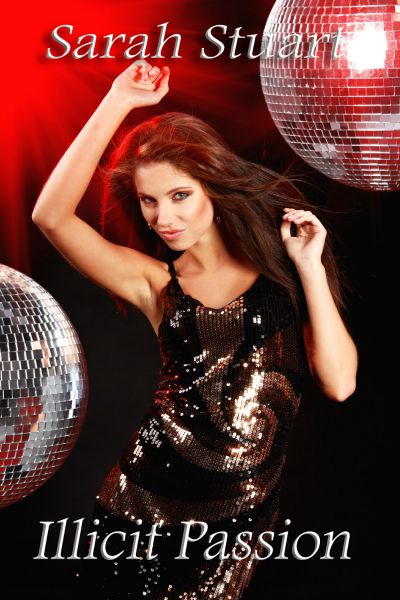

IAN: Is Illicit Passion published in print, e-book or both?

S. Stuart: Illicit Passion is published only as an e-book at present. A print copy will follow in time for Christmas.

IAN: Where can we go to buy your book? 

S. Stuart: Illicit Passion is available at all Amazon sites at viewbook.at/ILLICITPASSION 

IAN: Do you use an outline or do you just wing the first draft?

S. Stuart: The Royal Command books are character-driven: I never knew the end until I reached it. There was a point in Illicit Passion when I didn’t know whether someone would live or die. Dangerous Liaisons began as a love story, which it is: readers familiar with the queen’s command “to find love where ye may” will understand how that grounded Lisette’s reaction to acting lovers opposite her father onstage. The promise to obey the queen’s decree, asked of every heiress, creates a potential minefield.

IAN: Do you have a specific writing style?

S. Stuart: Yes, I do. I never use dialogue tags; I see no need for them. Each chapter may be divided into two or three parts: each uses the POV character’s name once and after that everything that is done or said, is done or seen to be done, said or heard, by that character, and all thoughts are theirs. It seems to be fairly unusual: judging by the reviews, it works well. 

IAN: What do you hope your readers come away with after reading Illicit Passion?

S. Stuart: That they will question the morality of killing for fun, whether an animal species is endangered or not. To understand that being a Christian isn’t about being perfect; it’s the ability to recognise one’s wrong-doing, try to make it right, and to forgive.

If that seems a serious answer when my novels tend to be regarded as steamy, it’s because nobody likes being preached at and I avoid doing it. The primary purpose of a novel is to provide entertainment and escapism: I hope my readers lose themselves in a different world. 

IAN: How much of Illicit Passion is realistic?

S. Stuart: All of it. Where I have used actual historical characters, like Margaret Tudor, Henry VII’s eldest daughter, the fiction fits into her recorded life, even to the degree of her being in the right place at the right time. Kinloch Wildlife Reserve, featured first in Dangerous Liaisons, was a working shooting estate: I know a lot about wildlife but I owe an ex-gamekeeper for facts about the running of such an estate, and the financial risk of converting it to a reserve. The theatre, and the basis of many of my characters, comes from my own experience. I was living in Wales when a producer of the musical “Annie”, to be staged at the Arts Theatre that is part of Aberystwyth University, asked for a dog to play Sandy. I had several obedience-trained dogs at the time and I supplied one whenever required for six years. A dog-handler must be present at all times so I had the opportunity to meet countless directors, performers, and all the backstage staff. Some of the musicals and plays were on their pre-West End premiere run and the actors and actresses were truly international stars. Hounding by the paparazzi occurs more in London, and it can be vicious if they scent a story. 

IAN: If you had to choose, which writer would you consider a mentor?

S. Stuart: I was lucky enough to have a mentor, the late, great, “first lady” of romantic suspense, Mary, Lady Stewart. Some years ago I had an article about the rescue of a stranded dolphin published and in it I referred to the knowledge I’d acquired from reading about a similar situation in “This Rough Magic”. She contacted me, which was a great thrill. She read one of my early, unpublished, novels and told me the main protagonists, the lovers, should meet in the first chapter, not a third of the way through the book. I followed that advice in Dangerous Liaisons, and introduced Lisette and her blackmailer in the prologue of Illicit Passion. If I could choose a writer to replace her it would be Nicholas Sparks; a reviewer compared my writing to his, specifically “The Notebook”, which I hadn’t read. I did, and I’ve been a fan ever since.

IAN: What book are you reading now?

S. Stuart: Screamer by R. E. Wood. It’s a thriller, gripping to the point of being frightening and very well written.

IAN: Are there any new authors that have caught your interest?

S. Stuart: Several: Sharon Brownlie (Betrayal), Bruce A Borders (Inside Room 913), Robert K. Swisher Jr. (A Circle Around Forever), Ica Iova (She Never Got to Say Goodbye), Rebecca Bryn (Touching the Wire), May Panayi (Malbed Mews), Tara Ellis (Bloodline), Bethany Turner (I’ve Loved These Days), and John Fioravanti (A Personal Journey to the Heart of Teaching). 

IAN: Name one entity that you feel supported you outside of family members.

S. Stuart: My “one entity” includes a vast number of people I have never actually met. It astounded me after I hit “publish” for the first time and asked around on Twitter and Facebook for advice on publicity, how many other authors made practical suggestions. The group spread rapidly to encompass “strangers” from all over the world, many of whom weren’t writers, but all had something to give, and willingly still do. I make a point of doing the same for new authors when I can. “Indie”, to me, means freedom, but it can be lonely too. One example of a friend I haven’t met is a reader fan from Texas who found me on Goodreads and sent me a message quite recently. “I hate you. I’ve read eight chapters, can’t stop, and I should be at work!” Later, she wrote one of my best reviews on Illicit Passion.

IAN: Tell us about your next book or a work in progress. Is it a sequel or a stand-alone?

S. Stuart: Dynasty of Deceit will be the last book in the Royal Command series: another standalone. It is plotted and the first two chapters are complete. I’m also committed to writing a short story for a charity anthology in 2016. However, the Royal Command series is on hold for the present. I’m working on a new novel, still based in show business but with a very different slant.

Monday, October 5, 2015

Rebecca Bryn: The IAN Interview


I live on a smallholding in West Wales with my husband, rescue dog and a flock of sheep. A self-taught artist, I paint the fabulous coastal scenery in watercolour and have work in private collections worldwide. I love walking, gardening, good company, and anything creative. My stories reflect my interests and my concerns, my love of family, animals and the countryside, my hatred of injustice and intolerance, my determination, and my sometimes gravely-challenged ability to forgive. I’m fairly laid-back, have developed a pretty thick skin, and I rarely get angry. I suppose I’m a contradiction.


IAN: Please tell us about your latest book.

R.B.: Touching the Wire, my second published novel, is set the Nazi death camp of Auschwitz, in 1944-45, and also in 70s and present-day England. It’s a story of the women of the holocaust and the effects the holocaust still has on our lives. It’s dedicated to the memory of a very special Polish Jew whose pain haunts me still.

Miriam, a Jewish nurse, steps down from a cattle wagon into the heart of a young doctor. As their relationship blossoms, they fight to save lives amidst the horrors of a death camp, joining the camp resistance and risking death daily. Liberation catapults them from one hell into another as they are separated. While Miriam is left behind in the camp infirmary, sick with scarlet fever, the doctor is forced onto the March of Death across Poland in the bitter January of 1945, taking with him stolen evidence of war crimes.

In post-war Britain, to protect his new family, the doctor fails to keep his promise to reveal the truth about the death-camp doctors and is haunted by guilt. It’s his granddaughter, Charlotte, seventy years later and fighting her own demons, who unravels her grandfather’s past and keeps his promise to his lost love.

IAN: Where can we go to buy your books?

R.B.: My second novel, Touching the Wire is available in e-book or print at http://author.to/TouchingtheWire

My first novel, The Silence of the Stones, a psychological thriller set in West Wales is available at http://author.to/TheSilenceoftheStones also in e-book or print.

IAN: Tell us about your next book or a work in progress. Is it a sequel or a stand-alone?


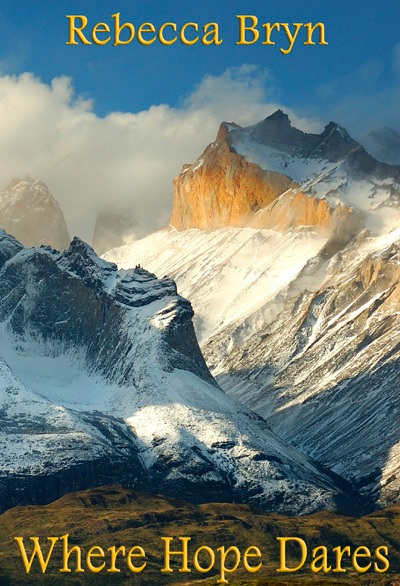
R.B.: Where Hope Dares is my third novel, a stand-alone thriller, and I hope to release it later this month.

Where Hope Dares is available for Kindle at http://getbook.at/WhereHopeDares

It’s a story of courage, faith and hope in the eternal struggle of good over evil.

In a time of social, religious and political upheaval, two isolated cultures clash with devastating results. Kiya, a young healer, is kidnapped and brutally raped by Alaric the Chosen to fulfil the ancient prophecy of The Gift. He takes her north across the High Atlas Mountains of Morocco to the high priest of one of his people’s pagan gods.  Raphel, Kiya’s storyteller husband, embarks on a thousand-mile journey to rescue her from the high priest’s warmongering regime. Kiya and Raphel both look to Abe, an enigmatic peddler for aid, but Abe has a secret agenda of his own – a prime directive dictated by a long-dead pope. The two lovers find help where they least expect it, but who can they really trust – friend or foe?

IAN: What inspired you to write Where Hope Dares?

R.B: Where Hope Dares was inspired by current scientific thinking about the past, present and future of our planet, and mankind’s less than beneficial stay upon it It’s also inspired by our strange relationship with our gods, and religious and racial tolerance as a whole.

IAN: Did you use an outline or do you just wing the first draft?

R.B.: I rarely use an outline. I have an idea of a beginning and a notion of the end. How I get from one to the other is largely down to my characters and where they take me. It’s usually a dramatic, painful and circuitous route, for them and for me.

IAN: How long did it take to write Where Hope Dares?

R.B.: Where Hope Dares was actually the first novel I wrote, back around 2004. Then it was called Destiny, and wasn’t very good: I’ve learned a lot about writing, character development, settings and research during the last eleven years. But I always liked the story, and still felt strongly about the issues that led to its conception so, last year, I decided to rewrite it. I spent about six months converting the tale to my new and, hopefully, more readable style of writing. I then sent it out to beta readers who informed me of its many shortcomings. Obviously much had been lost in ‘translation’. This was a setback I hadn’t anticipated but I was undaunted: all criticism is valid and useful – it’s just a matter of knowing how best to make use of it and apply it. Fortunately, one reader, who has since written me a brilliant scientific ‘afterword’, suggested I gave a more prominent role to Abe, an itinerant peddler and one of my minor characters. It took several months to ponder how this could be achieved and how it would impact the plot, and six more to weave what was essentially a new character into the original story, but it has transformed the novel, given it added depth and lifted it, I think, to a higher plane.  So, you could say it’s taken me eleven years to write Where Hope Dares.

IAN: What do you hope your readers come away with after reading Where Hope Dares?

R.B.: Oh gosh. That’s a difficult question to answer. I hope they value what and who they have. I hope they see greed and intolerance as evils. I’d like to think they’ll see our planet as a fragile and beautiful thing that we should protect at all cost, not plunder indiscriminately for a quick buck: it’s the only one we have and we have a duty of care to all the creatures that share it with us. I hope they see religion for what it is, a comfort and a way of life to those who believe, whatever their creed, not a weapon to beat others’ religions with. I’d better get off my soap-box.

IAN: How much of the book is realistic?

R.B.: The science behind it is as up-to-date and factual as I can make it. The history of the Oromo people and the settings were researched, as were the biblical texts that drive the underlying story and sub-plot. The characters and the coming together of the three aspects of the tale are entirely figments of my imagination.

IAN: How is Where Hope Dares different from others in your genre?

R.B.: I’d like to think it digs deeper, both into mine and my readers’ psyches. I’d like to think there are important issues underscoring the story: things like love, loss and hatred, tolerance, faith and what we build faith on, the errors of corporate greed, political and religious idealism and fanaticism whether for good or evil, and the diminishing resources and overpopulation of our planet.

IAN: If you had to choose, which writer would you consider a mentor?

R.B.: I think Tolkien’s skill at creating great characters with moral strengths and weaknesses, and providing richly-described settings and a believable, totally-grounded and historically-documented world has to be the greatest influence in my writing. Not that I could ever hope to emulate his work.

IAN: Name one entity that you feel supported you outside of family members.

R.B.: My long-time friend, Sarah Stuart, author of romances Dangerous Liaisons and Illicit Passion, has been a huge support throughout my life and my writing career. She is my harshest and most honest critic, and also helps with editing and proof-reading my novels. (aka tearing apart rubbish and ‘upcycling’ it J)

IAN: Did you learn anything from writing Where Hope Dares and what was it?

R.B.: All the research into my novels has taught me something. The Silence of the Stones taught me about rune-casting, in fact I actually used real rune-casting to drive the story, and also it opened my eyes to mental illness. Touching the Wire gave me a humbling insight into the holocaust and makes me grateful daily for what I have. Where Hope Dares kept me awake at night, thinking of what man is doing to the earth, but the research also gave me hope that the planet will survive despite our attempts to destroy it. The writing process itself has made me realise that I never give up. The bigger the challenge, the higher I climb.

IAN: Do you have any advice for other writers?

R.B.: Research, research, research. Then write, take criticism and act on it if it improves your writing and the story. Rewrite, edit, proof-read, take on board suggestions with an open mind but stay true to yourself. Don’t try to write in isolation: join a writing group – The Word Cloud on-line forum is a great place to start. And keep at it. It’s a huge learning curve and, after three published novels and several unpublished ones, I realise that the more I learn the less I know.

IAN: Do you have anything specific that you want to say to your readers?

R.B.: I hope you enjoy my tales as much as I enjoyed writing them. On a higher plane: appreciate what you have, love with all your heart, bear no malice, care for our planet – teach your children well: they are our future.

IAN: What were the challenges (research, literary, psychological, and logistical) in bringing your three books to life?

R.B. Another interesting question. I do like a challenge! Time to do the research, and write and promote is a huge challenge. The learning curve has been almost vertical at times, and encompasses aspects of writing and publishing I had no idea existed.

I think for me, the main challenge, apart from learning my craft, is allowing myself to dig deeply into the painful parts of my life and laying my soul bare to my readers in order to give life to my characters. In that respect, writing has been cathartic but it hasn’t always been easy. In my early attempts at writing I tended to gloss over emotion, as I often did in life. But the results were bland, superficial, false and, as in life, unreal. By bringing my own pain and emotion to the surface, I’ve made Alana, a struggling artist in The Silence of the Stones, a woman fighting to carve out her own path and free herself from her mother’s apron strings and the feeling she has of responsibility for her mother’s happiness. Walt, in Touching the Wire, suffers the guilt we all carry in one respect or another: by tapping into my own I could show the effect it had on his life and his family. Kiya, in Where Hope Dares, has my determination and my eternal optimism, though her faith is far stronger than mine will ever be. 

Wednesday, September 9, 2015

Dianne Astle: The IAN Interview


Dianne Astle has worked at a variety of jobs in her life. She has been a draftsperson, a news correspondent for a radio station, a teacher’s aide, and most recently had the opportunity to practice servant leadership in a faith community. Dianne loves fishing, riding horses, and walking with her dog. She lives with her husband Doug, his three cats and her beloved dog Thomas.


IAN: Please tell us about your latest book.

D.A.: The release date for Ben and the Watcher of Zargon is September 25th.  This is the write-up from the back of the book. Grade ten isn’t turning out the way Ben hoped. His best friend is no longer Ben’s roommate, but has been replaced by a strange boy who follows him everywhere. Jealousy awakens the dragon fire within Ben when the girl he likes returns to school with a boyfriend. That fire and the scales peeking out from under his shirtsleeves are making it difficult to keep his secret. Ben needs to go to his mother’s home world to learn how to transform into a dragon. If the training comes to late Ben is in danger of becoming something that is neither human nor dragon.


IAN: Is Ben and the Watcher of Zargon available in print, ebook or both?

D.A.: Ben the Dragonborn and Ben and the Watcher are available as print and ebooks.  They are or will be available through Amazon and I hope to have them available through IngramSpark soon.

IAN: Will Ben and the Watcher of Zargon be available for Pre-order at Amazon?

D.A.: Yes, it is now at this link.

IAN: What motivated you to write?

D.A.: I went for a walk with a friend and we both said we would like to write a novel one day. When I said this I didn’t think I would ever do it. My life was rich and full. I wasn’t looking for something more to give it meaning.  However, one day the idea for a story came to me. Once I started to write the characters into existence it was too late to turn back. I was in love with them and the world they lived in. I needed to let them live. Sometimes they come and speak to me in the night and I wake up with a smile on my face.

IAN: How long did it take you to write your books?

D.A.: My first book took me seven years to write.  After it was finished, I sent it out to traditional publishers and got some very encouraging rejection letters. More than one publisher kept it for a long time because it was on their ‘maybe’ pile. When I moved and took a new job, I put Ben the Dragonborn on a shelf for another seven years. My second book took me only seven months to write. I am still editing it, but it must be finished by September 15th

IAN: Who designed your book covers?

D.A.: The current cover on both my books was designed by photographer and artist, Sean Sherstone. I originally asked Sean to do a Youtube video for Ben the Dragonborn. He did an awesome job and then very kindly volunteered to set up a web site for me.  When I was thinking of a new cover he was the first person I asked.

IAN: Do you have a specific writing style?

D.A.: I do not have a specific writing style.  I start at the beginning and write with a vague idea of where I’m going. If I have any writing style it is that I spend a lot of time rewriting and editing.

IAN: What were you hoping your readers would come away with?

D.A.: I was not thinking of what I wanted my readers to come away with when I first wrote Ben the Dragonborn.  All I was interested in doing was telling a good story.  However, one of the major themes in the book has been a major theme in my life. A central theme of my life is the importance of being an original and not a copy.  I have often been heard telling others to seek the treasure of their own true selves. In Ben the Dragonborn, Ben must discover who he truly is to help a world in need of peace. In the second book, Mack must accept who he is and the destiny that is his and his alone for the sake of all six worlds. In the third book the brownie is on a journey of self-discovery and change which will have an impact on all brownies and two of the six worlds.

IAN: What books have most influenced your life?

D.A.: One book that had a profound impact on me was Alexander Solzhenitsyn’s Gulag Archipelago.  In Solzhenitsyn’s story of being a prisoner in the Russian Gulag there were people who were true to themselves and the call to love. They often died rather than sacrifice who they were. Other people were willing to do whatever it took to survive. They lived, sometimes at the expense of others, but also at the expense of their own self-respect. They lost an important part of themselves. The Gulag Archipelago communicated to me that the most important thing I can do is be true to myself and what I believe. 

IAN: What was the hardest part of writing?

D.A.: The most challenging aspect of my writing is that I had learning disabilities in school. Not only that, but I was a dreamer off in my own little world when important things were being taught, like where a comma belongs. Correct grammar is still a struggle for me even though I now have a Master’s degree. In my first book I felt that I could by-pass hiring an editor. That was a mistake. The second book has had the benefit of two editors and a creative writing circle. Recently, I took the step of having Ben the Dragonborn professionally edited by Ashee Enz of Clean Edits. I did this even though it was getting glowing independent reviews. I made most of Ashlee’s suggested changes.

IAN: What book are you currently reading?

D.A.: I am currently reading Kathy Huth Jones most recent release. I am really enjoying Mercy’s Prince. I had to put it aside for the time being because of publishing deadlines, but I can’t wait to get back to it.

IAN: What new authors have you discovered?

D.A.: For a long time my favorite authors have been Terry Brooks, Stephen Lawhead, J.R.R. Tolkien, C.S. Lewis and J.K. Rowling. In the past two years I have discovered wonderful authors among  the self-published.   Sudan by Ninie Hammon was a particularly powerful and moving story based on real life events.  I also really enjoyed Hubris by P.A Wilson, Flight of the Griffin by C. M. Gray, and Aranya by Marc Secchia. It is impossible to name every excellent independent author I have read in the last two years. I need to say that twitter works for promoting books. I would never have considered reading a book about Amish vampires; however, Barbara E. Brink was so creative in her tweeting that I picked up her books and loved them.

IAN: Tell us about your next book. Is it a sequel or a stand alone?

D.A.: My next book will likely be entitled Moses and the Dragonborn.  I have laid the groundwork for it in Ben and the Watcher of Zargon.  Ben, his uncle Zinc, Allison, and a brownie named Moses are chosen to go to Farne to rescue Ben’s dragonborn grandfather.  If Moses and the Dragonborn unfold as I expect it to, then the most important story line will be about Moses and the brownies.  I hope to have this book out by the summer of 2016. 

Monday, August 31, 2015

Laura Garrett: The IAN Interview

 Laura Garrett, author of What Happens After "Happily Ever After?" and Creating Your Own Fairytale Life has written both books based on her professional and personal experiences with relationships and life skills. She is a licensed professional counselor who graduated with a master’s degree in Counseling Psychology from the University of Denver and a second master’s degree in Adult Education and Training from Colorado State University. She is currently in private practice with over 20 years’ experience in relationship, mental health, and addiction issues. 

Laura has worked with hundreds of individuals and couples who struggle with relationships, self-esteem and other life skills. She knows what it takes to acquire and master the tools needed for the purpose of having a happy and fulfilling life. Laura is eager to share this insightful knowledge with her readers. 

IAN: Please tell us about your latest book.


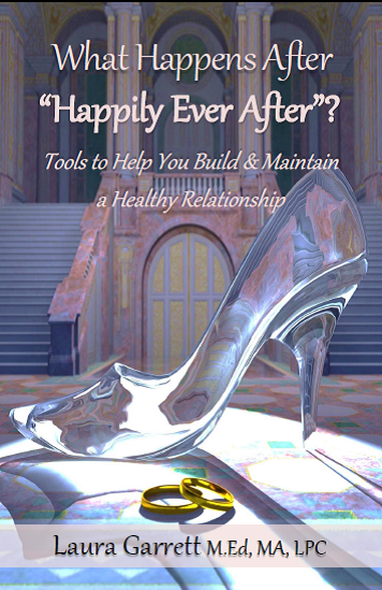
What Happens After “Happily Ever After”? Tools to Help You Build and Maintain a Healthy Relationship.

L.G.: As we grow up, we learn about fairytale romances where a prince and princess fall madly in love and live “happily ever after.” But what happens after the “happily ever after” when the romance fades and real life gets in the way?

In What Happens After “Happily Ever After?” we meet a Fair Maiden who is at a crossroad in her marriage with her man. She sets out on a journey of self-exploration and a quest to unlock the secrets to a happy and fulfilling relationship. It is here she happens upon a Wise Fairy Guardian who offers a relationship skills seminar for all the land. With the help of the Wise Fairy Guardian, the Fair Maiden learns about the realities of being in a relationship, the work that it takes to maintain a healthy relationship and the skills that are needed to ensure its success.

This book provides you with tools to help you build and sustain a healthy relationship with a significant other. The book is an easy, fun read, offering 6 important relationship skills that are essential to the success of your relationship, to include building a relationship with yourself. 

IAN: Is What Happens After “Happily Ever After”? published in print, e-book or both?

L.G.: Both

IAN: Where can we go to buy your book?

L.G. Here https://www.createspace.com/5020576

IAN: What inspired you to write What Happens After “Happily Ever After”?

L.G.: I have been a mental health therapist for over 20 years working with hundreds of individuals and couples who struggle with relationship issues.
I wrote this book because I strongly believe that everyone deserves to be in a happy, healthy, long lasting relationship and I believe they exist, with some work and know how. Having both personal and professional experience with relationships I felt passionate about sharing the tools and skills that I offer my clients with others who may not otherwise seek counseling. The skills presented in this book use a cognitive behavioral approach that has been proven effective in the improvement of relationships.

IAN: Did you use an outline or do you just wing the first draft?

L.G.: While I was pursuing my second Master’s degree in Education I took a class on program development. I developed a relationship skills training that I intended to present in a 9 hour workshop. While reviewing the outline I decided to use that as the template for my book which ended up writing itself.

IAN:
What do you hope your readers come away with after reading your book?

L.G.: It is my greatest hope that the information presented in this book will help readers to re-evaluate their expectations in relationships and more importantly of their partners. We are all just human trying to live our lives the best we can with the hopes of finding a compatible partner to share it with. There are no super heroes or fairytales and if we can approach relationships for what they really are then perhaps we can alleviate the unnecessary broken hearts and love turning to hate that so often result from entering relationships for the wrong reasons.

IAN:
How is your book different from others in your genre?

L.G.: What Happens After Happily Ever After is written as a fairytale narrative to make it fun and easy the learn the five necessary skills for building and maintain a healthy relationship with a significant other.

IAN: What books have most influenced your life most? 

L.G.: Don Miguel Ruiz and Eckhart Tolle’s books have been most influential, particularly The Mastery of Love and The Power of Now. Both books have inspired me to live in the present moment and approach others with the same love and compassion that I would have for myself.

IAN: Name one entity that you feel supported you outside of family members.

L.G.: I would definitely have to say my editor. It was her great sense of humor, love and support, in addition to her invaluable input that made the writing of both books possible. It also made the growing pains of this project worthwhile.

IAN:
Is there anything you find particularly challenging in your writing?

L.G.: I never really considered myself a writer; I have always been a therapist first and foremost.  Therefore my biggest challenge was wrapping my head around the idea of being an author. As for my writing, the main challenge was ensuring the concepts in my head were thoroughly delivered in concise and understandable way.

IAN: Who designed the cover?

L.G.: Originally Stephani an artist from Milan, whom I found at 99 designs, designed the first cover of my book, I have recently changed it to the second cover as it was more appropriate for my target market and it better depicts the message and content of the book. My editor designed both covers.

IAN: What was the hardest part of writing your book?

L.G.: The hardest part of writing this book was the introduction. I had the content but had no idea how to deliver it in a creative way. So I started the book with “Once Upon A Time”, just to get started, the plan was to write the content and then change the introduction, however, once I started to write, as mentioned earlier, the book just wrote itself, so I left beginning as it was.

IAN: Tell us about your next book or a work in progress. Is it a sequel or a stand-alone?

L.G.: The second and final book, Creating Your Own Fairytale Life, Seven Keys to Your Happily Ever After has been released, June 2015. This book is the prequel to What Happens After “Happily Ever After”?  It is the book that teaches you how to have a relationship with yourself prior to being in a relationship with someone else. In this prequel, the Prince, under pressure from his parents to marry and rule the Kingdom, takes to the forest on a quest for self-discovery.  He meets a helpful Wizard, who enlightens him about the seven most important skills needed to succeed in life and to overcome any obstacle to peace, success, and Happily Ever After.

By using the 7 fundamental life management skills offered in this book you will learn to build your self-esteem, manage your stress and anger, learn to identify your feelings so you can communicate them and resolve conflicts more effectively, in addition to learning cognitive reframing skills.  Once practiced and mastered, you will be empowered to trust yourself, have confidence in your decisions and embrace you very own fairytale life.  This book is available on Amazon and through this link:  http://www.createspace.com/5472243

Siafa B. Neal: The IAN Interview

Siafa B. Neal

I am the first author in the history of the game of Advance 3-D Chess to conceive of the idea of practically playing chess from a 3-Dimensional perspective.  My unique, one-of-a-kind chess books contain Diagrams, Illustrations, Drawings and Photos displaying key information about the game board, the Longitudinal Star Gate 14 Model, Model III, which makes the games fun and easy to understand.  It is imperative that readers understand the fundamental aspects of conventional chess to allow for the easy digestion of the new information which my chess books so vividly portrays.  My chess books and E-books contain the Equations or Statements of each movement of the chess pieces relevant to the game(s).  The equations display the symbolic mathematical elements and spatial relationships and relativity of the chess pieces on the game board.  The language of chess is indeed an expression of mathematical spatial relativity.  I work hard to provide to my audiences the necessary tools that makes relearning the game entertaining and easy to understand.

IAN: Please tell us about your latest book.

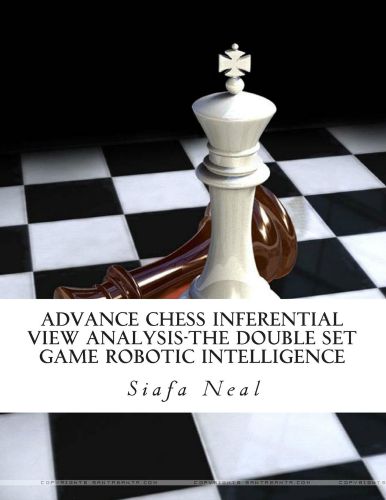
S.B.: My latest book is entitled – Advance Chess : Inferential View  Analysis – The Double Set Game Robotic Intelligence. Its Subtitle is: The Double Set Game – Book 2 Vol. 2

My next book is yet to be published is entitled:
Advance Chess : Random Access to Problematic Probabilities.  Book 2 Vol. 3.  

The book’s subtitle is: The Hybridization Polymerization of Matrix Poly-Plextics Informatics.

IAN: Is your book published in print, e-book or both?

S.N.: My books are published in both print and e-book.

IAN: Where can we buy your books?
 
S.N.: My books can be bought at Amazon.com 

www.independentauthornetwork.com/siafa-b-neal

IAN: What or who inspired you to write Advance Chess?

S.N.: My cousin , Robert H. Brown , who is currently a British citizen residing in England and who holds a doctoral degree in English was influential in my decision to try a writing career besides my Engineering interests.  Writing is a magnificent tool that enables me to promote ideas about Advance Chess to help enlighten others about the new styles and forms of playing Advance 3-D Chess as opposed to the rather draconian ways of conventional chess and offers some important moral compass for those readers who have an open mind to newer opportunities to explore and to exhaust the tapestry of psychological warfare under the philosophical guidance to exhaust the possibilities to newer ,informative approaches to life in general.

IAN: How long did it take to write Advance Chess?

S.N.: The time frame to complete and to publish each book averages about a month.

IAN: How did you come up with the title?

S.N.: I sought after title that are captivating and attention grabbing.  Due to the sophistication of my books’ content, I describe the books’ titles that adds to my books’ complex nature.

IAN: How is Advance Chess different from others in your genre?

S.N.: My book differentiates from other similar genre books in that field on the market in that it offers special unique Diagrams, Illustrations, Drawings and Photos about the space-aged games of Advance 3-D Matrix Vector Logistics Chess, the first of any kind that is currently available in the marketplace.
IAN: What books have most influenced your life most?

S.N.: The books that have influenced my life most are: “The Tale of Two Cities” written by Charles Dickens and other similar book by the same author.

IAN: Do you see writing as a career?

S.N.: Writing has the potential of becoming a possible career choice.  Presently this choice is in synchronization with my Time availability and Talent Resources (efforts, skills, aptitude ).

IAN: Do you recall how your interest in writing originated?

S.N.: My interest in writing probably originate in high school in my English classes.

IAN: Do you have any advice for other writers?

S.N.: The publishing business has a competitive market with many authors both well-known, because the readership love their style or genre of writing and unknown because the author may be new to the industry.  It is important that you work in your genre stands out from the crowd of published authors. One may have to ask oneself the following questions to succeed in the book writing industry:

a. What makes my work unique?
b. Why would a reader want to read my book?
c. Am I allowing my published work speak for itself without being so pretentious?
d. Do I emulated a passion for writing my book?
e. What would compel a reader to purchase my book?
f.  Do I have the right organizational skills to write my next book in an orderly sequence and format?

IAN: Tell us about a work in progress.

S.N.: My next book is a sequel or series of books that discusses the Double Set Games for the Longitudinal Star Gate 14 Model, Model III.


Tuesday, August 18, 2015

Jane Davis: The IAN Interview

Jane Davis


Jane Davis is the author of six novels. Her debut, Half-truths and White Lies, won the Daily Mail First Novel Award and was described by Joanne Harris as 'A story of secrets, lies, grief and, ultimately, redemption, charmingly handled by this very promising new writer.' The Bookseller featured her in their 'One to Watch' section. Five further novels have earned her a loyal fan base and wide-spread praise. Jane is regularly compared to more seasoned authors such as Kate Atkinson and Maggie O'Farrell. 

Compulsion Reads describe Jane as 'a phenomenal writer whose ability to create well-rounded characters that are easy to relate to feels effortless.' Her favourite description of fiction is 'made-up truth'.

Jane lives in Carshalton, Surrey, with her Formula 1 obsessed, beer-brewing partner, surrounded by growing piles of paperbacks, CDs and general chaos. When she is not writing, you may spot Jane disappearing up the side of a mountain with a camera in hand.

IAN: Please tell us about your latest book.

Jane Davis: At the age of forty-six, Anita Hall knows exactly who she is. She has lived with partner Ed for fifteen years and is proud of all they’ve achieved. They go out into the world separately: Ed with one eye on the future in the world of finance; Anita with one foot in the past, a curator at Hampton Court Palace. This is the life she has chosen - choices that weren’t open to her mother’s generation - her dream job, equal partnership, freedom from the monotony of parenthood, living mortgage-free in a quirky old house she adores. The future seems knowable and secure. But then Anita finds herself standing in the middle of the road watching her home and everything inside it burn to the ground. Before she can come to terms with the magnitude of her loss, hairline cracks begin to appear in her perfect relationship. And returning to her childhood home in search of comfort, she stumbles upon the secret that her mother has kept hidden, a taboo so unspeakable it can only be written about.

IAN. Is An Unknown Woman published in print, e-book or both?

Jane Davis: Both.

IAN: Where can we go to buy An Unknown Woman?

Jane Davis: At these retailers. Amazon.co.uk   Amazon.com  Smashwords  iTunes/apple  Kobo  Inktera  OysterBooks  Scribed

IAN: What inspired you to write An Unknown Woman?

Jane Davis: I’ve chosen some fairly meaty subjects for my previous novels: religious visions, prostitution, knife crime, the protection of vulnerable adults. With An Unknown Woman, I didn’t deliberately set out to write about a ‘big subject’. Instead, I began to write what I thought was a simple story about a family placed under the microscope when crisis brings them together. I wanted to tackle the subjects that are relevant to the life I’m living now (which bears no similarity to what I imagined when I was a child and my father used to tell me, “When you’re an adult, you can do exactly as you like.”) It’s about how material possessions inform our sense of self; the extension of youth into what used to be thought of as middle age; and what it’s like to be childless when the majority of friends have children, even when childlessness was a positive choice.

Basing the threads very loosely on my elderly neighbour’s personal experience, I also explore the issue of what happens when the bond between mother and daughter is absent. In my neighbour’s case, the women in his wife’s family only had daughters and were unable to form any sort of bond with them. He spent his married life guarding his wife’s secret by being both mother and father. It was only when I sent my manuscript to beta readers that I realised, far from being a ‘small story’, this issue is more common than I could have possibly imagined. But while the subjects of post-natal depression and delayed bonding are openly discussed, the sense of shame that a mother experiences when she cannot love a child – sometimes a child who was very much wanted – precludes that same openness.  

IAN: How did you come up with the title?

Jane Davis: I used the working title The Things that we Lost in the Fire, but changed it when a song of the same title was released. By that time, An Unknown Woman had taken on various meanings within the book. It’s central character, Anita, whose job is a curator at Hampton Court Palace, is obsessed with a painting called The Portrait of an Unknown Woman, which depicts a woman who was previously thought to be Queen Elizabeth 1 - except that she’s shown as being heavily pregnant. Secondly, Anita is also interested in the women whose names have disappeared from history, and, thirdly, it is the title of the book within a book.  

IAN: Are experiences based on someone you know, or events in your own life?

Jane Davis: Other than using my neighbour’s story, not intentionally, although I’m afraid the answer turned out to be a resounding ‘yes’. The action begins with my main character, Anita, standing outside the house she and her partner have lived in for fifteen years and watching it burn to the ground. It is very recognisably my house.  My partner and I joked about how I might be tempting fate. But it was just a joke. We aren’t terribly superstitious – although I must admit that we’ve had more near misses during the last year than I’m comfortable with. (There may be some truth in the saying, “You attract what you think most about”.)  

Then in February 2014, when I was about halfway through writing the book, my sister and her husband lost their house and practically everything they owned to the winter floods. She lived on the island on the Thames that you can see in the first photograph in this article: http://www.dailymail.co.uk/news/article-2555658/UK-weather-16-areas-South-warned-flooding-danger-lives-Armed-Forces-battle-save-homes.html. Suddenly there appeared to be an extra layer of meaning in every line I wrote.  

IAN: If you had to do it all over again, would you change anything in An Unknown Woman?

Jane Davis: The loss of my sister’s house made me question if I should abandon the project. The imagined scenario I had been writing about become a reality for someone very close to me. I gave her the choice, which was possibly a little unfair. I didn’t realise at the time I made the decision to continue, or even when I went to press, that 18 months later, they would only have just received planning permission to rebuild. At the moment, they’re still living in rented accommodation with what little they managed to salvage. Their lives will still be in limbo for another year or so yet. However, it was clear that the shape of the book had to change. The other day, I stumbled across this quote: “The writer’s job is to get the main character up the tree, and once they are there, to throw rocks at them.” While Anita finds one hell of a lot of rocks flying in her direction, I chose my ammunition more carefully than I would have done otherwise, replacing a few sharp flints with smooth pebbles.  

IAN: Did you use an outline or do you just wing the first draft?

Jane Davis: I never write an outline, but I don’t see the alternative as ‘winging it’. I am a gradual layer-er, and that takes time. With the exception of Half-truths and White Lies, which virtually wrote itself, none of my published novels bear any resemblance to their early drafts.
I like George R R Martin’s quote: ‘I’ve always said there are two kinds of writers. There are architects and gardeners. Architects do blueprints before they drive the first nail, they design the entire house, where the pipes are running and how many rooms there are going to be, how high the roof will be. But the gardeners just dig a hole and plant the seed and see what comes up.’ Personally, I think there are more than two types of writers. I want to be Mary Anning scouring the beaches at Lyme Regis for dinosaur fossils, or Howard Carter discovering the tomb of Tutankhamun, or metal detectorist Terry Herbert digging up the Staffordshire Hoard. What I don’t want to be is a parent deciding on my child’s future, telling my son which subjects he will study, arranging my daughter’s marriage. 
Every time you introduce a new angle, each ‘what if?’ question has to be pushed to its limits. Setting material aside and revisiting it is an excellent practice. It allows far greater objectivity. You have to analyse what isn’t working any why, then once you have the structure you go back and make every page shine.
The pivotal moment of a novel may not actually reveal itself until several edits in, or until an editor comments, ‘I see the point that you were trying to make.’ As author Roz Morris says, sometimes it takes a reader to hold the mirror up to your work. 
This certainly wasn’t the first time I have substantially altered the focus of a book during the course of its writing. I’m afraid that anyone who imagines that words show up in the eventual order that they appear on the page of any novel is, in the majority of cases, mistaken. In some ways, the novel in its final form is an illusion. The rabbit pulled out of the hat – or in the case of An Unknown Woman, the few things pulled from the wreckage of a burning house.
IAN: What do you hope your readers come away with after reading An Unknown Woman?

Jane Davis: The fire quickly becomes the least of Anita’s problems. It is the psychological fall-out and what happens when she is stripped of her armour that drives the narrative. She has to find the answer to the question, ‘If we are what we own, who are we when we own nothing?’ I suppose that I’m asking the reader the question too. The answer is that we are not the same. But, as with the altered plot of a novel, there can be positives. I think the overall message is that when one door closes, another opens.
IAN: Who designed your book covers?

Jane Davis: I work with graphic designer Andrew Candy on my book covers (although my newest cover was designed by Jessica Bell). Having already established a strong brand, the way we operate is that I come up with the concept for the design, and source the images and Andy executes it using his marvellous eye and technical wizardry, which, frankly, is beyond me.

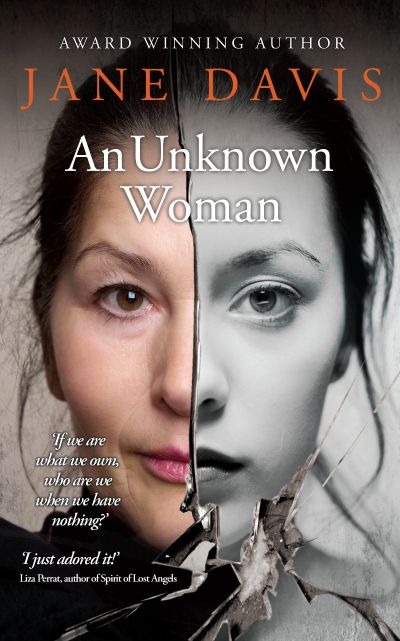
As with the title, the image for the cover of An Unknown Woman has more than one interpretation. There is the fraught mother/daughter relationship in the book, but there is also the idea of looking in a mirror and finding that the person staring back at you is not the person you expected.

Andy gets the credit for finding the image of the older woman. Trying to find photographs of two women who could be two halves of a whole, without the result looking photo-shopped was a challenge. I was tearing out my hair when he got lucky and struck gold. Photo libraries tend to rotate images, so one day you can find nothing at all and on another day the perfect image will appear within moments, as it did for him. I’ve had people ask if it’s the same woman, but of course it isn’t. It’s the arch of the eyebrow that makes it so convincing. I think it’s probably my most commercial book cover to date. 

IAN: Who is your favorite author and what is it that really strikes you about their work?

Jane Davis: If I have to pick one author, it has to be John Irving. I’m currently re-reading Cider House Rules. As for what strikes me about his work, my answer today is totally different from what it would have been had you asked me a few years ago. What I love about Irving’s writing is his skill to tackle complex subject matter with simple language. You’ll never find him shying away from an uncomfortable scene. When I started to write, I wrote the type of book that I loved to read. I left school at the age of 16 and had never been to a creative writing class. No one had told me that there were rules. What strikes me is that Irving breaks every rule - he constantly head-hops and he veers away from the main story for several pages to explore the background of a minor character – but his storytelling style is no natural that he does this eloquently.     

IAN: Name one entity that you feel supported you outside of family members.

Jane Davis: I belong to a writers’ group, but everybody there has written a book so I’m not a novelty. I’m a member of the Alliance of Independent Authors (ALLi) and I’ve had great support there, and have collaborated with several members on various projects. Last year, my novel An Unchoreographed Life was included in a multi-author boxset, ALLi member Jessica Bell designed the new cover for I Stopped Time and ALLi member Jane Dixon-Smith designed the interiors for the new editions of my books. I’m brand new to the Independent Author Network so I’m looking forward to getting to know other members. But the greatest support I’ve had has been from members of my keep fit class (Moves Fitness). I’ve been working out with the same group of people twice a week for the past 25 years. There are about 400 classes dotted around the country, which if you do the maths gives me access to 12,000 potential readers, many of whom fit the demographic I’m after. Among the people in my class I have found several amazing beta readers and proofreaders whose talents are being wasted at work, so they’re very keen to put them to work. There is buy-in from those people, and my instructor allows me to sell books before and after class. When we put on large-scale events such as charity fundraisers, I donate the profits of my books while getting considerable exposure. My advice to other authors is to never be afraid to ask for help. The response may surprise you!  

IAN: Tell us about your next book or a work in progress. Is it a sequel or a stand-alone?

Jane Davis: My work in progress is a standalone novel. It’s the story of a radical poet and political activist who is a cross between Edith Sitwell and Vivienne Westwood. Having been anti-establishment all of her life, she is horrified to find that she’s been featured on the New Year’s Honours list. (This is list prepared by the Queen for people who have made a considerable contribution to British life in some substantial way – arts, culture, business, charitable works and so on).