Pages

Tuesday, November 4, 2014

Scott Sonnon: The IAN Interview


Scott Sonnon grew up battling severe dyslexia and physical disabilities, while his single mother worked multiple jobs to make ends meet.

A poor student, Sonnon was advised to set his expectations low, and was forcibly institutionalized for “disruptive classroom behavior.”

Rejecting limitations, Sonnon became five-time martial arts World Champion and coaching Team USA.

His fitness systems transformed the industry, and are used by more than 50,000 military Special Forces and other elite units, including the U.S. Federal Law Enforcement Training Center, Customs and Border Protection Advanced Training Center, Marshals Service Training Academy and Army Special Operations Aviation Regiment.

Sonnon lives with his wife, Jodie, and their two children in Washington.

Q. Please tell us about your latest book.

A. In a unique, bite-sized format developed through years of writing daily social posts for his tens of thousands of followers, five-time martial arts World Champion Scott Sonnon recounts inspirational lessons he’s learned battling dyslexia, physical challenges, opponents in the ring and daunting personal and business challenges.

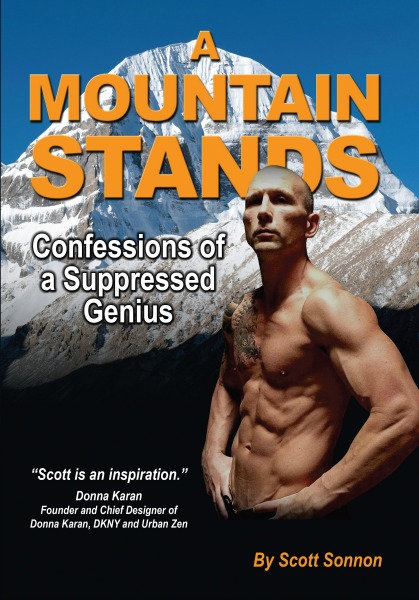
In “A Mountain Stands: Confessions of a Suppressed Genius,” Sonnon for the first time recounts how he was hospitalized in a children’s psychiatric institution for “disruptive classroom behavior.”

He eventually managed to recast his dyslexia as an advantage. His recent TEDx talk on these issues has reached more than 50 million people.

“My fellow dyslexics are ignored, neglected, and in many cases, abused and shamed for our unique neurological wiring, yet are among the greatest contributors to our world,” Sonnon said. “Dyslexia is our genetic advantage – our suppressed genius.”

The Hall of Fame trainer known as the “Flow Coach” distills his experiences along with guidance from some of history’s greatest thinkers into practical life advice that applies equally to those coping with their own unique learning styles, as well as those struggling with life decisions.
This book will provide inspiration for children and adults facing labels of learning disabilities, as well as those suffering the ravages of obesity, the trials of post-traumatic stress, the affects of bullyism and the physical challenges of aging.

Q. Is your book published in print, e-book or both?

A. 
Both
Q. Where can we go to buy your book? 


http://www.amazon.com/Mountain-Stands-Confessions-Suppressed-Genius-ebook/dp/B00NJ5CI9E/ref=tmm_kin_swatch_0?_encoding=UTF8&sr=1-1&qid=1414448166

Q. Why did you write “A Mountain Stands: Confessions of a Suppressed Genius”?

A. Benjamin Franklin, one of America’s most fascinating dyslexics, once wrote, “If, at first, your idea isn’t absurd, there is no hope for it.” Five years ago, I had an absurd idea: Each morning, I would write a story about my life. In that story, I would find the positive benefit it had brought, even if I didn’t understand it at the time. Beginning with my darkest moments, the most traumatically piercing events, I exhumed a life of suppressed damage to determine the positive coping skills I adapted as a result.

The stories would eventually form a book that even someone like myself - a dyslexic - could read and absorb. The concept of “micro-chapters” evolved: Short stories (some less than a page), but each of which unfolding a “Hero’s Journey” as Joseph Campbell describes: an obstacle, a failure to overcome it, the finding of a higher purpose, the collection of allies and assets, a successful but surprising reattempted victory, and the sharing of the decoded discoveries previously locked within them.

Q. In simple terms, what is dyslexia and how common is it?

A. Dyslexia is often perceived as a language disability, and this is accurate: When forced into most traditional educational approaches, a “dyslexic” has difficulty with language. But this is because of a specific way that a dyslexic’s brain is organized. A simple explanation is that they have more “grid cells” (on the hypothalamus) and so their brains interpret two-dimensional language into three-dimensional shapes, causing reading, writing and even speaking challenges.

But that same 3D nature of their brain allows them to see the world from incredible faceted perspectives and gives rise to their innovative, entrepreneurial, creative mind. It is a gift with trade-offs, like anything. We must make our goal to help dyslexics realize their gifts, and provide them with strategies and support to mitigate the trade-offs.

As much as 20 percent of the population has it: that’s over 60 million Americans, and 1.4 billion people worldwide.

Q. Who are some famous dyslexics in history?

A. Some of our greatest contributors had dyslexia: from both Edison and Tesla in electricity, from both Wright brothers to Richard Branson in the power of flight, from Alexander Graham Bell to Steve Jobs in telecommunications, from Sir Isaac Newton to Stephen Hawking in physics, from Da Vinci to Disney in art, and Washington to Kenned in politics.

Q. Your book describes how your mother was your greatest advocate and defender, yet you felt betrayed when she allowed you to be institutionalized. How did that happen?

A. I was disruptive in my classrooms. I didn't try to be. As Albert Einstein cautioned, “If you judge a fish by its ability to climb a tree, you will always be frustrated, and that fish will always feel stupid.” I had assumed I was stupid, especially when called so, and my teachers always felt frustrated, especially since their teaching and testing methods fixated on approaches which amplified my “trade-offs” as “learning disabilities.” I objected and attempted to self-advocate. I rebelled. I felt the world was against me. This neither excuses nor indicts my behavior. It was what it was ... a socially manufactured psychological environment that was preventable.

My mother was my strongest advocate, and she did a superhuman job of rearing me in a time and in circumstances where it should have been impossible for me to survive and thrive. She did that, despite my inability to recognize that I was worsening the situation with my rebellion. It’s taken half a lifetime to unpack that experience, and feel neither blame nor guilt.

Q. How does your childhood experience affect you as a parent?

A. My children suffer from a condition known as “childhood.” They get into arguments. They make blunders. They say and do inappropriate things. Like every human who ever endured “childhood” does. The negative effects that my children experience involve me reading into those natural experiences of growing, and seeing something other than it is. Sometimes, I have to step back and let my wife teach me what “normal” is.

So, I let myself just be a big kid with them. Within that age-appropriate sphere, we play together. I make mistakes, and I try to forgive myself and realize that I will not break them with a parenting error. And I try to exhale and step back, as they grow out of one sphere, and are ready - all too soon - for the next larger one. Someone please write a book!

Q. We recently lost the great comedian Robin Williams to suicide. He described himself as having severe dyslexia. Is there a possible link between dyslexia and suicide?

A. There’s no physical link between dyslexia and suicide. There may be a link between abusive shaming of those who are different, and the lifetime burden of estrangement this forges.

When I was much younger, I attempted suicide, but a friend intervened and help arrived, thank God. The thought went through my mind, “If I am alone, truly alone, then what does it matter, especially if it hurts so much?” My mother, my mentors, my dear friends helped me realize, despite the story I had accepted as a true self-­‐ identity, I was not separate.

I am “alone, together” with everyone in the neurodiverse world. When I lacked  courage, they helped me turn around and encourage others. And that has made all of the difference.

Q. Your book mentions that your son seems to have dyslexia, but not your daughter.
How can a parent tell if their child has dyslexia, and what can they do about it?

A. My daughter has her own unique brilliance, equal but different than my son. She's an interpersonal, auditory and musical/rhythmic learner, so she repeats everything she hears, thinks and reads in order to “latch it in,” and all the while she twirls, flits and taps. It’s like a cacophony to a kinesthetic, intrapersonal, spatial thinker – like her Dad. So, we have an interesting family dynamic.

For the parents listening, especially those whose children may be struggling in the school environment, there are definitive tests for dyslexia that will offer conclusive evaluation. I highly recommend contacting the local chapter of the advocacy group Decoding Dyslexia for support and guidance.

Q. One of your quests has been to help battle the kind of stress that killed your father and continues to kill our police and Fire Fighters in their mid-­50s on average. What techniques did you develop, and how can our listeners use them?

A. The exhale portion of breathing is tied to the “relax and recover reflex,” just like the inhale is tied to the “Fight or Flight reflex.” So, the obvious tool to use is our exhalation when facing stressors.

However, it sounds easy to think “just exhale” until a sudden, new, different type of stressor hits us, and instead we inhale and brace in response. This dumps a chemical cocktail into our bloodstream, embedding into our fatty tissues and causing cumulative damage.

How we breathe under stress is determined by how we have trained ourselves to breathe. Therefore, I interweave breathing techniques into exercise. Unfortunately, most exercise programs unwittingly reinforce distress, adding to the problem.

Q. You have invented several unique Fitness programs and earned the nickname “The Flow Coach” based on the links you discovered between movement and brain function. How do they work?

A. Movement is an “idea” in your mind. How you think you can move determines how you actually can move. The corollary is that if you improve your movement, you expand your neural network.

Like Oliver Wendell Holmes said, “A mind once stretched by a new idea cannot return to its original dimensions.” This is because the brain is plastic. It’s actually the scientific term -­‐ neuroplasticity. The brain isn’t like a rubber-­‐band where you stretch it with a notion, and then it rebounds when you stop thinking about it. It’s like a plastic bag, where once you stretch it, it stays that way. Once you see things from a different vantage point, you can’t unsee them. Your brain always has that alternate viewpoint available.

Movement allows us to expand our mind’s eye, so the more we play, the more our brain bolsters its function.

The goal is to get underneath the reflex of fear, of disbelief. If you don’t believe you can move a certain way, and you’re afraid to do it, not only can you not move that way, but your body defensively braces against it, causing pain and injury if you attempt to do so.

I had very strong beliefs as to my potential, but great aspirations as to what I wanted to achieve, so I had to create escalators of baby steps, micro-­‐advancements that would stay underneath the radar of my fear and disbelief, stretching my mind one micro-­‐movement at a time. It is the steps forward, and the recovery steps when our pain and injury cause us to back-­‐pedal, that are the truly revolutionary strategies in body-­‐mind integrative development.

Q. Do your programs help with weight loss?

A. Yep, and abs too! Weight loss and muscle gain are natural byproducts of expanding your movement potential, and expanding your mind’s eye of your potential.

Q. How many previous books have you written?

A. I have written 7 books, and 11 manuals.

Q. What is the target audience for this book? Who can apply these lessons and stories to their own lives?

A. My book is for anyone who faces challenges and seeks support, inspiration and strategies for transforming obstacles into opportunities. And face it, we all need help from time to time.

Q. Are all of these stories based on First hand, real-­life experiences?

A. There are a few stories told to me by others, but primarily they’re my personal experiences, from which I've sought to glean insights, through the lens of the great thinkers and philosophers referenced throughout the book. (Some names and details have obviously been fictionalized out of respect for their privacy.)

Q. Where does the inspiration to write a particular story come from?

A. Inspiration is a fickle muse: you either wait for it, or you systematically create the environment for it to happen, and then practice it until it does. When you’re beset with negativity, inspiration might never come, so I learned -­‐ through my teachers’ guidance -­‐ to set a clock every day, and begin writing an answer to a question: Take this negative experience, and reflect upon the wisdom of the great minds and hearts; how then would you re-­‐frame the experience into a positive one?

After 13 years of practicing this process every day, there are now few times that I cannot realign the value of a difficult moment. They still happen, of course, but they're manageable, and I am not long from recovering to a positive perspective. I captured the best stories over this decade plus of refinement, and compiled them into a chronological anthology. This is the value of the book, more so even than the adventures of the stories: the PROCESS of each story offers the reader an alternative approach to facing their own challenges.

Q. What is your message? Is it only limited to one thing or group of people?

A. My message is simple (but not easy): You either succeed, or you learn. And I've learned much more than I've succeeded.
Although
many people will advise you to celebrate successes, and to a degree I agree, I've learned to be error-­‐focused, to become enamored with my mistakes, and to revel in my shortcomings, for hidden within them is our capacity for growth.

Often, hidden in our misperceived flaws, we find our true genius. Only our skewed perspective keeps us blind to our innate gifts.

My book is an allegorical mirror to reflect to my readers not my story, but their own ... and inside of their story ... their own suppressed genius.

Unearthing that brilliance will take courage, patience and persistence, not because of the difficulty of sharing it, but in the internal and external resistance to believe you’re not brilliant. We are taught to be “normal” -­‐ a term used in sociology for the median, the average ... the mediocre. Shining is discouraged because it makes you an outlier.

You weren't meant to fit in, though. You were meant to stand out... to Stand like a Mountain. My book is meant for anyone who wants to stand up for themselves and for others.

Q. What is the greatest challenge you have overcome as a dyslexic in order to become a published author?

A. The most difficult part of that self-­‐acceptance came in knowing the difference between my language difficulties -­‐ the “trade-­‐offs” of being a dyslexic -­‐ and my neurological innovations in thought and expression -­‐ the advantages of being dyslexic.
What I do to editors should be classified as torture. Joking aside, writing style has been defined by rigorous guidelines of accepted grammar and story development format ... despite the radical dyslexic genius of writers such as William Shakespeare, Agatha Christie, WB Yeats, F. Scott Fitzgerald, Jules Verne and George Bernard Shaw. It’s simple to think that when you have these literary giants as examples, you must immediately feel confident in your own innate style. But that simple rationality isn't easy to embrace.

Growing up being labeled as “stupid and slow” carries generational weight: it not only lasts your entire lifetime, but it can be passed on to the next. At some point, you have to muster lifetimes of courage and just... own who you are and how you express it.

Q. What would you say today to your teachers and doctors who encouraged you to aim low when you were just a child?

A. I would apologize to my teachers and doctors for not being self-­‐confident enough to show them a new reality, to provide them with the cognitive dissonance strong enough to wake them from their dogmatic slumber.

They only suffered from the ignorance of that generation. We now know differently. NOW there is NO excuse for what they did then. Now, it should be considered criminal, knowing what we know of neurology. But then, it was just the highest expectation of education. Those rare few who advocated for me were outcast as heretics, and would be now considered our innovative educators reforming our educational system.

I would also thank them, for they became motivation for me, to prove them wrong. Rebellion isn't always helpful, but sometimes ... especially against wrongdoing, it is a necessity. Unfortunately, I made many mistakes in ill-­‐focused rebellion, which further imprisoned my freedom to express myself.

Teachers and doctors have a much broader and deeper educational experience   now ... and can understand the nature of childhood rebellion: we are not attempting to be disruptive; we just can't figure out, in our young minds, how to fit our round peg into the square hole. Today’s professionals are helping us find holes that fit us as individuals. We should help them as much as humanly possible!

Q. How do you choose what you write about each day? And, how do you find time to write with your busy schedule?

A. Life chooses what I write about, because there is never a day that passes without a wealth of lessons, even in the most seemingly mundane domestic task, like weeding the garden.

One of my most impacting teachers, whom I write of in my book, Dr. Jonathan Ellsworth Winter, talked often about the dyslexic Vincent Van Gogh’s preoccupation with one of his masterpieces – “A Pair of [Peasant] Shoes.” Dr. Winter explained that these simple, dirty, battered shoes represent more art and life than the most opulent cathedral. He taught me the elegance of the simple things. So, I look for them, and see lessons everywhere, even in the simple, dirty, battered shoes of my children.

What joy looking at them brings me! Time is another illusion which writing has allowed me to dispel. The more that we practice on a regular schedule any skill, the more efficient it becomes, and the more time we GAIN. So, with any skill, you have the appearance of the least amount of time at the beginning because we are the least efficient at that -­‐ and many other -­‐ skills.

Setting a time, beginning to write, stopping when the set duration is complete, trains you to become more efficient. Over a decade of practice at this method has allowed me to choose any moment to tap into the inspiring body of ever-­‐present simple beauty of life, especially the misperceived negative moments, and reflect the lessons with which they are saturated.

Q. Does your family support your publication of these personal stories?

A. My poor wife endures a thousand retellings of the same story. She does so with a patient smile (and an occasional eye-­‐roll).
My children are still young, so not all of the stories are appropriate for their ears. I strive to learn-­‐on-­‐the-­‐job how to parent in a way that assumes my own childhood experience is not necessary for them to thrive. My growth has not been as a compensation for how difficult my childhood was, but rather my growth has been because of embracing the innate gifts I (and we each) have to offer, and dedicating my life to sharing them.


That has not been an errorless journey, even as a husband and parent. They have suffered my growing pains... and yet, they still love me. How amazing is that?!

Tuesday, October 14, 2014

The wait is over! Book Three in the Andy Smithson series is finally here!


In Disgrace of the Unicorn’s Honor, Andy discovers more than he bargained for when his parents reveal his mom's past and he realizes she will die when he breaks the curse unless he intervenes.

Now twelve, Andy returns to Oomaldee to find its citizens on edge after many have been turned into vulture-people. Against this background, Andy and his company embark upon the next quest, to retrieve the horn of a unicorn. But not long into it, a seductive voice calls to Andy, tempting him to surrender the next ingredient in exchange for a promise to preserve his mom. Will he be able to stop the transformation of Oomaldee’s citizens? Will he jeopardize his ability to end the curse to save Mom?

You won’t want to miss the non-stop action, drama and thrills on this adventure that is Disgrace of the Unicorn’s Honor!

"Andy Smithson will take on any problem that comes his way. The scenes and dialog in this book come alive on the page. I felt Andy’s emotions and victories, and I was with him for his pain and recovery. This is an amazing adventure that I have been impatiently waiting to read since book two!" - Rena Marthaler, Rena Writes (Rena is 10) 

"Sometimes, I just let the 5 star rating speak for itself. I can add nothing more." - Wayne Walker, Home School Book Review

"A long-lasting story that is part of one of my favorite series."
- Erik Weibel, This Kid Reviews Books Blog (Erik is 13)

Available in Kindle and Paperback


Book Four: Resurrection of the Phoenix’s Grace (Andy Smithson series) is coming Spring 2015.


Book One


eBook 1, Andy Smithson: Blast of the Dragon’s Fury is now FREE. Pick up a copy at Smashwords, Kobo, Google, B&N. You can also listen to the FREE podcast of Book 1 on iTunes. Book one is also available in paperback.


 Book Two


Book 2, Andy Smithson: Venom of the Serpent's Cunning is available in Kindle and Paperback.


L. R. W. Lee writes to teach her readers principles that can transform their lives – overcoming frustration, impatience, fear and more. She also shows why responsibility, diligence and dignity are the keys to true success in life. L. R. W. Lee lives in scenic Austin, TX with her husband, daughter and son.
Connect with L. R. W. at: 
Twitter   Website   Facebook

For more about author L. R. W. Lee: 
http://tinyurl.com/ln2dqjz

Tuesday, August 5, 2014

Charles E. Yallowitz: The IAN Interview

Charles Yallowitz was born and raised on Long Island, NY, but he spent most of his life wandering around his imagination. One day he returned from his fantasy world and decided he would share his stories with others. Eventually his wife decided that she was tired of hearing the same stories over and over again, so she convinced him that it was time to follow his dream of being an author. Now, locked within the house under orders to shut up and get to work, Charles brings you Legends of Windemere. He looks forward to sharing all of his stories with you and his wife is happy he finally has someone else to play with.


The Independent Author Network. Please tell us about your latest book.

Charles Yallowitz. My latest book is part of my ongoing fantasy series, Legends of Windemere.  This series follows the adventures of Luke Callindor, a young warrior who is determined to be a hero like his ancestors.  He is has more courage and bravado than common sense, which puts him in the path of a Lich and its dark master.  As the series progresses, Luke makes friends with other young heroes and learns that the gods of Windemere have big plans for him.

In their most recent adventure, Family of the Tri-Rune, Luke and his allies return to the city of Hero’s Gate.  It has been plunged into chaos due to his friend, Nyx the Caster, having unleashed a forbidden spell in the city’s defense. Now they must survive thieves, goblins, and a new breed of undead born from Nyx’s magic. Ghosts from the past are waiting in Hero’s Gate, but the most dangerous thing might be the revelation that one of our heroes has been living a lie.  It all builds up to a cliffhanger ending that leads right into Legends of Windemere: The Compass Key.

IAN. Is Family of the Tri-Rune published in print, e-book or both?

C.Y. All of my books are in eBook and Paperback.

IAN. Where can we go to buy the Legends of Windemere series?


IAN. What inspired you to write the Legends of Windemere series?

C.Y. I’ve wanted to be an author since high school and I was always drawn to fantasy books.  I started designing my own world when I went to college and continued my hobby of Dungeons & Dragons.  During one of the sessions, I thought of how I could use the characters for my books and the game could act as a testing area for storylines.  Everyone agreed it would be fun to play a game that turned into a published series, so I outlined the stories as we went and let my world grow around the new concept.  I quickly learned that I couldn’t use everything and alterations had to be made between the two mediums.  The game ended around the halfway mark of the plot, which left me to work on Windemere without the pre-existing material.  I took a little bit from everywhere and nowhere to create the world, characters, and stories and it’s become very different from the original inspiration.

IAN. Do you use an outline or do you just wing the first draft?

C.Y. I’m a big planner when it comes to my stories.  I have notebooks filled with character bios, monster write-ups, magic items, and whatever else has come to my mind over the years.  Part of this is because for about 10 years, I could only find time to outline future stories or edit what I finished.  Any idea that came to my mind was pursued during lunch breaks.  It eventually reaches a point where I have breakdowns of ‘chapter targets’ in a traditional outline format.  All that being said, these plans tend to get drastically changed once I sit down to write the actual book.  For example, I’ve occasionally found a chapter that can be absorbed into another or I switch characters for major events because the original choice wouldn’t be involved.

IAN. Do you have a specific writing style?

C.Y. I write using present tense third-person with a lot of action and dialogue to bring out the characters.  This style limits the amount of exposition that I can do and any world history has to be explained through conversations or a prologue.  I won’t deny that writing in present tense causes some confusion because most people aren’t used to it.  The funny thing is that I honed this style by accident.  I used to mix up present and past tense all the time when I was in high school.  A teacher told me to pick one, which ended up being present tense.  Nobody ever pointed out that it was an uncommon style, so I’ve been using it ever since and now it’s where I’m most comfortable.

IAN. How did you come up with the title?

C.Y. A lot of trial and error for the series and book titles.  Calling my first book Beginning of a Hero was the easiest since it’s where Luke Callindor sets off to become a hero.  The others all went through various titles due to the focus of their stories changing.  As for the series itself, Legends of Windemere has an epic saga feel to it and reveals the scale of story.  Windemere came about when I was sitting on a lakeshore trying to think of a name for my world and the wind was really strong.

IAN. What do you hope your readers come away with after reading your books?

C.Y. I write to entertain, so I always hope that my readers come away feeling like they went on an adventure.  I’m always hoping to hear about favorite characters and scenes when someone tells me they read my book.  If someone walks away with something deeper than a joyful smile then I see that as extra.

IAN. How is Family of the Tri-Rune different from others in your genre?

C.Y. It comes down to the world and a focus on characters.  I see a lot of modern fantasy heading away from magic, monsters, and quest-based stories.  There is more interest in political tales that are closer to reality than those with elves, orcs, and magic swords.  I’m heading in the opposite direction with my books because Windemere has magic everywhere.  The best way to explain this is that most fantasy worlds have it that wizards are unique to the point where they are awed or feared.  I’ve gone in a direction where they’re rather common and treated more like tradesmen.  It’s more the level of power that gets them attention instead of simply having magic since it’s not a rare resource.  Same goes for monsters that can be found alongside mundane animals.

As for my focus on characters, I use the quest adventure as a backdrop for the interactions between heroes.  Luke Callindor, Nyx, Sari, and the others are young and will evolve as they face their hardships.  So there are scenes where they wonder what happens after their adventures are done or if they’ll even survive their destiny.  Even if they fail in their adventure, the story can continue because I have brought attention to the heroes as fluid beings that will exist after their trials.  I am seeing stories that are more about the character development than the adventure, so this might be a growing trend.

IAN. Do you see writing as a career?

C.Y. Yes.  I’ve wanted to make a career out of writing for the last 19 years.  Wow, I’m old.  This is what I love doing, so if I can make a living that allows me to forge my stories every day then I’d be very happy.

IAN. Is there anything you find particularly challenging in your writing?

C.Y. I write with an ensemble cast of characters, so one of the big challenges is making sure everyone gets some ‘screen time’.  This becomes very difficult in conversations because I’m having to balance 6-7 voices at the same time.  So I need to find balances or give some characters a reason to not be involved even if they’re in the scene.

Another challenge stems from my use of present tense.  As stated, I can’t show history like other fantasy books that use blocks of exposition.  In my style, it comes off very much like a clumsy info dump.  This means I have to be precise in the historical information that I give in narration.  Another method is to have characters explain things in dialogue since it isn’t always a given that the heroes know the origin of everything they’re facing.  This does result in me having to leave some of the more whimsical facts out because they’re not relevant to the plot.

IAN. Who designed the covers?

C.Y. All covers for Legends of Windemere are done by Jason Pedersen.  He’s very talented and I’m thankful that he’s willing to help me out.

IAN. Do you have any advice for other writers?

CY. Keep on writing and always make it fun.  Never let anyone tell you that it’s a waste of time.  Just keep pushing forward and cherish even the small victories like finishing a first draft or surviving your first editing run.

IAN. What were the challenges (research, literary, psychological, and logistical) in bringing it to life?

C.Y. The biggest challenges with the latest book were consistency and continuity.  I use a lot of foreshadowing, so I have to repeatedly go back to research my previous work.  A slip of a character’s behavior or a mistake in preexisting information can snap a reader out of the story.  All of the quirks, actions scenes, descriptions, and whatever else I use to bring the book to life can be easily undone by an error in one of these two categories.  This has caused me to write slower than when I started because whenever I have a feeling that something is off, I stop to go back through the previous volumes.  Even when I don’t think I made a mistake, I’ll go back to check at the end of the day.  Better safe than sorry because many readers will pounce on every mistake.

IAN. Tell us about your next book or a work in progress. Is it a sequel or a stand-alone?

CY. My next book is entitled Legends of Windemere: The Compass Key.  This is the 5th book of my fantasy series and it definitely has more action than the previous volumes.  A lot of the storylines and rivalries that have been established will come to a head in this book to make way for new villains and the revelation of the heroes’ true quest.  One could say that this is where the series takes a more serious and slightly darker tone because the characters will be pushed to their physical and mental limits.

One of my favorite things about The Compass Key is that I got to create a lot of new monsters for many of the battles.  I’ve always enjoyed creature creation in fantasy, so this book allowed me to go wild with a few ideas that were previously nothing more than vague notes on a piece of paper.

Tuesday, July 22, 2014

Simon Duringer: The IAN Interview

Educated at Mostyn House School in Cheshire; Simon became involved in writing from an early age. At the age of 13, under duress he was torn away from playing tennis and made to enter the school writing competition which he subsequently won. But to this day he blames said competition for only making the second pair in the school tennis team!
A self-confessed geek, Simon has a passion for mathematics and thoroughly abused that knowledge from an early age by writing probabilities for those playing the school masters at pontoon (21) and poker. Not that he believes in blame culture, but it could be deduced that his success at winning sweets at cards during his formative years has contributed to his six pack transforming prematurely into a one pack! His book "How Do I Win on a Lottery?" became a number #1 amazon bestseller in its genre...
A writer of many genres, yet probably better known for interviewing other authors than for his own books, but nonetheless enjoys scribbling, ranting and making up stories that chill, thrill and entertain.

Independent Author Network. Please tell us about your latest book.
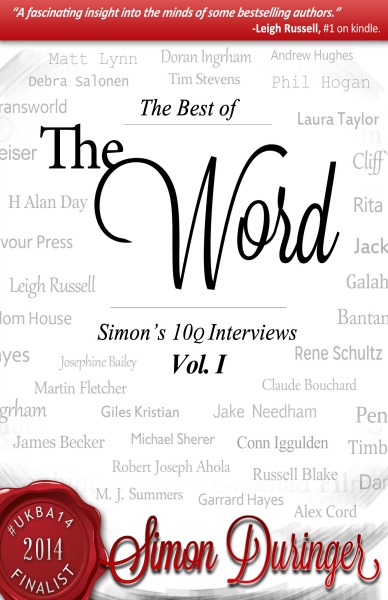
Simon Duringer. The Word – Volume 1. The book delivers 28 bespoke interviews with successful writers; from debut sensation MJ Summers to the Veteran; DuPont, Royal Academy, 5 x Emmy Award winning war correspondent and for 20 years Head of NBC News International, Martin Fletcher. Simon puts them in multiple situations from the sublime to the ridiculous. From time travel to being marooned on desert islands, each set of circumstances has been designed specifically for the individual interviewee’s circumstances and is intended to draw out their inner personalities. Simon breaks down the layers of stardom to reveal the true individuals beneath the glitz. The results are nothing short of fascinating – The interviewees never fail to entertain, whilst also; informing, sharing and creating “out of genre” responses that delight the readers. This is no ordinary set of interviews and the collective trophy cabinet of those within is dazzling! With 10% of all royalties going to the veteran’s charity, The Royal British Legion, and with even bigger names in the planned Volume 2, it is worth getting on board early!
IAN. Is The Word published in print, e-book or both?
S.D. I am a great lover of traditional books and whilst the majority of the marketplace is now eBooks, I chose to publish in both kindle and paperback versions for all my offerings. The Word is slightly different as the kindle version has illustration whilst the paperback does not, so in effect they are treated by Amazon as two separate entities, albeit not by choice. All my books are also currently available on Prime and therefore Amazon Prime members can borrow them for free.
IAN. Where can we go to buy The Word?
S.D. The links I would suggest using are those of my amazon author pages which are as follows;
My books are also available through search on other global amazon sites and via my website: http://www.simonduringer.com
IAN. Do you have a specific writing style?
S.D. I find that to be an incredibly difficult question to answer. Honestly? I don’t know… I don’t tag myself with any particular style or model my work on that of others. It would be nice to think I have my own unique style! However, rather than disappoint or not answer, I have trawled through past emails and correspondence from readers and found this email from a reader in Canada, Isabel Galloway, who sent me a wonderful message late last year whilst reading Stray Bullet. This sums up the answer way better than I could. I quote;
“At the beginning it reminded me of Mark Billingham but now I realize that you are more Peter James. Have you heard of him? His novels are all in Brighton. You have the sense of him, I think. And the racy bits remind me of Micky Spillane! Haha!”
IAN. What do you hope your readers come away with after reading your books?
S.D. I want my readers to be astonished, surprised and delighted! I attempt to deliver a story that will challenge readers’ imagination. I want them to attempt to decipher the outcome without making it too straight forward. At the outcome I want them to smile, curse the author (in a “I want to do that again!” kind of way) and then sink in their chairs uttering the words “OMG, How the hell did I miss that!” I want to deliver plots that will dumbfound, yet, without patronizing the reader in hindsight be obvious. I want them to be motivated to come back for more. But, most of all it has to be believable, plot lines must work and I must believe my own story before I can make it available to the reader. In summary, I want the readers to be entertained and left wanting more…
IAN. How is The Word different from others in your genre?
S.D. Whilst author interviews are bountiful online, The Word is unique. Each interview takes a vast amount of research time and is not designed to cater to the whims of those with new releases to pimp out to the masses. There are plenty of those around already. The Word attempts to challenge and probe in order to discover what the author is really about. I already know my interviewees are damn good writers, they have either been major award winners, debut sensations or have a unique quality that has caught my eye and intrigued me into approaching them for an interview. I am not looking for bland content to fill my website, or books, for the likes of Google or Yahoo search engines. I am looking for individuals of a like mind. Most of my interviewees, if not all, are far more talented at wielding a quill than I will ever be, and therefore through my interviews I can learn about writing, marketing and the publishing industry, whilst at the same time having my emotions rocked to their foundations by stories that are so sad, or so witty, or simply so incredibly full of creative thought. The Word has been an eight month rollercoaster and what I have outlined above is what has drawn the likes of Bernard Cornwell to my door; The 19th Globally Bestselling author of the decade (source – Daily Telegraph). His agreement to run the gauntlet of Simon’s 10 Q Interviews tells me I must be doing something right! He will be headlining The Word Volume 2. But ultimately it is the readers who will decide the fate of The Word, they are both judge and jury. Without big publishers or marketers behind me, my current quest is simply to get The Word in front of enough readers to allow that process to take its course.
IAN. What books have influenced your life the most?
S.D. I was always fascinated by two books penned by the same author, although of course there have been many… George Orwell’s 1984 is one of those. To see his ‘predictions’, which seemed so unbelievable back along, become reality, with me playing a small part in my mainstream career as an operations and control room manager, is something that astonishes me. Where it will all end who knows, but big brother is already watching you! Additionally, another George Orwell works, Animal Farm, which I read and subsequently watched as a feature length animation whilst still at school, had a great impact on the way I look at others. It displays how, in politics, whilst people might genuinely set out on a journey to improve the lives of others; conforming to establishment traditions, compromising on one’s beliefs, human nature and greed often erode those noble principles over time. I can look back over the course of history and see that as humans we don’t learn from our mistakes and regularly revisit the errors made by past generations. It wears me out sometimes as I find it all so predictable.
IAN. If you had to choose, which writer would you consider a mentor?
S.D. For me this is not a difficult question. In my life time I have had two people I consider to be mentors. One of which I still regard as such, the other, who was not a writer but an incredible man, sadly passed away some years ago. Josephine Bailey, or Godmother as I refer to her, has and continues to encourage me for no distinct reason other than being a good egg! She encouraged me to get started with interviewing and has been casting an eye over my progress ever since. She is an English Rose with a dash of heretic about her and I just feel it is a shame that she and her husband Sam live so far away in the US, though I am certain we will all meet in person one day! Prior to Jo there was a man who was our neighbor when we (my family) lived in Spain during the 1980’s. Possibly the most decent man I have ever known and once again for no apparent reason he took me under his wing for a time. Perhaps being cheeky to a man that nobody else ever dared to confront was what intrigued him into helping me, but John Lampitt who owned Blue Boar, Watford Gap services, Sheffield Ski Village, was referred to as the NCP of Switzerland’s car parking industry amongst other things and if I recall correctly owned sole rights to the sales of Mazda cars within Switzerland, was a great friend and source of inspiration to me. He had started life as a sergeant within the British Army and ultimately is a man I will never forget, though he was not a writer he taught me that anything is possible and I regularly think about him and the amazing things he achieved during his lifetime.
IAN. What book are you reading now?
S.D. I actually have four books on the go at the moment, all very different and all by authors that I know personally. Each is re-opened where I left off depending upon my mood at the time, they are all very good and are as follows;
Hotey by Josephine Bailey (my mentor) – This book is fantastic and I never tire of it. Sadly, it never received the exposure it deserves, Hotey is a contemporary novel and really should be made into a feature animation. There’s a lot in there to be learned both morally and in terms of great writing from Jo, who was voted by Publishers Weekly as Best Female Narrator a few years back.
Unsigned Unscene by John Winstanley – John is an author local to me who managed bands during the last decade. It’s a fly on the wall account of that time and the interviews he carried out. It is a cult book with a few similarities to The Word and whilst John has deliberately left famous individuals out of the book it does not detract from my interest in it.
Flat Out, Flat Broke by Perry McCarthy – This is a fascinating autobiography and reached the Top 20 motor books of all time. It takes the reader through Perry’s struggles to become a Formula 1 racing driver and all that happened between, including becoming the legendary driver The Stig of BBC’s Top Gear.
Finally, I have on my bedside table Daniela by debut author Georgia Melaris. Whilst her first novel, Georgia has been involved in editing and proof reading the works of many others. It’s steamy and not my genre of choice, but whilst I am only into the first couple of chapters of this one, I have 50 shades of hope for it and for her success!
IAN. Name one entity that you feel supported you outside of family members.
S.D. In a nutshell, Simon’s 10 Q Interviewees. They are all amazingly supportive and I remain in touch with the vast majority of them. They are all such fascinating and unique individuals and the wealth of knowledge and experience that they have between them is somewhat phenomenal. Learning from them and the new interviewees that come along is a key driver for me, it really keeps me motivated. Conversing with them is like bathing in a fountain of knowledge, or having the ability to delve into the cookie jar with no fear of getting your hand stuck. For me they are the cookies and there is an endless supply out there, the only reason that supply will deplete is, if and when, hopefully, in the future I become one of them, at which time I hope to offer up similar support to those around me.
IAN. Is there anything you find particularly challenging in your writing?
S.D. Writing both the thriller Stray Bullet and its sequel Phoenix has been a challenge as the stories are complex, full of twists and turns to keep my readers guessing to the very end. I believe, from reading the reviews, that I have achieved this. But as I write the books sporadically and sometimes take fairly long breaks between sessions of writing, I have had to re-read the narratives from the start on many occasions so as not to contradict or compromise the story line when writing fresh chapters. This is a time consuming process but ultimately I believe worth the effort. I would also guess that I am an undiagnosed dyslexic as I am aware that my grammar and punctuation leave something to be desired but am unable to fix it. I hand my work to professional editors, but for me, this is probably akin to an uninhibited author having a manuscript translated into a completely separate language, as in both instances I and they are in the same boat, rarely able to tell the differences post edit to pre edit and can only assume and trust that the professionals have done their job correctly. In the past this reliance on others has not served me well, but again I am in a position of learning and hold enough confidence in my storylines that this is something that can and will be overcome.
IAN. Who designed the covers?
S.D. I do a lot of the conceptual design work myself, indeed I produce my own promotional videos too. For The Word I simply didn’t have the time to commit to getting it “just right” and employed the services of a young and very talented designer from the US – Michael Price. We worked on the cover for months before getting it to a stage where I, and all those involved within the content of the book, was happy with its appearance. I am very grateful to Michael for his patience with us all! The theme is likely to carry on throughout the series.
IAN. Do you have anything specific that you want to say to your readers?
S.D. Yes, I love you one and all! For me, there is no greater honour than for somebody to consider paying money for something that I have created. Writing a book is a time consuming process and I, as many other authors, put my heart and soul into delivering work of a quality worthy of you the reader. Hours are spent pouring over ideas and concepts for the storylines. Unlike those prolific writers whom are able to churn out story after story, I take great pride in weaving a plot for personal and not financial gain i.e. one that will challenge the reader to use their own imagination if they are going to even get close to the outcome before it is revealed. As with interviews, there are countless shelves full of repetitive storylines, I have no wish to become a part of those formula led award winners. I commit to putting everything I have into each storyline which is possibly why my ideas take longer than most to get into print. But, bear with me, you may not find quantity but I hope you will continue to agree that you shall find quality here…
IAN. Tell us about your next book or a work in progress. Is it a sequel or a stand-alone?
S.D. The Word - Volume 2 is already completed and will be out towards the end of the year. Stray Bullet is being re-edited and re-covered for a second edition which will be out in due course and I am still working on Phoenix, the sequel to Stray Bullet, although I have not pressured myself into a time frame for publishing that offering.